
Radiant-Floor and Hydronic Heating Systems in Denver Luxury Homes: What Buyers Should Know
Radiant-floor and hydronic heating systems are common features in Denver-area luxury homes because they can provide quiet, consistent, and comfortable heat without relying entirely on forced air.
Instead of heating rooms primarily by blowing warm air through ducts, hydronic systems circulate heated water through tubing, radiators, baseboards, or other heat-emitting components. In a radiant-floor system, the tubing is installed beneath or within the floor so heat rises gradually into the occupied space.
When properly designed and maintained, radiant heat can provide excellent comfort. Floors feel warm, room temperatures remain relatively even, and the system operates without the airflow noise associated with furnaces and supply registers.
The system can also be significantly more complex than it appears from inside the home.
A luxury property may contain several boilers, circulation pumps, mixing valves, manifolds, thermostats, floor-temperature sensors, and dozens of individual heating loops. Radiant floors may operate alongside forced-air furnaces, air conditioners, domestic water-heating equipment, snowmelt systems, and other hydronic components.
A thermostat responding or a boiler producing hot water does not necessarily confirm that every zone, pump, valve, and floor loop is operating correctly.
Evaluating these systems requires understanding how heated water moves through the home and whether the equipment, controls, and floor assemblies are working together as intended.
Key Takeaways
• Hydronic systems use heated water to distribute heat through radiant floors, radiators, baseboards, or air handlers.
• Luxury homes may contain many independently controlled radiant zones.
• Radiant-floor systems respond more slowly than forced-air systems, which affects how they should be operated and evaluated.
• A boiler may operate while individual pumps, zone valves, actuators, or floor loops remain inactive.
• Thermal imaging can provide useful information about active heating patterns when operating conditions are appropriate.
• Evaluating a complex hydronic system requires understanding the boiler, distribution piping, controls, floor construction, and building as a complete system.
What Hydronic Heating Is
Hydronic heating uses water as the medium for transferring heat through a building.
A boiler heats the water and circulation pumps move it through a network of piping. The heated water travels to one or more areas of the home, releases heat, and then returns to the boiler to be heated again.
Depending on the design, the water may flow through:
• Tubing embedded within concrete floors
• Tubing installed beneath wood-framed floors
• Wall-mounted radiators
• Hydronic baseboard heaters
• Towel warmers
• Air-handler coils
• Snowmelt systems
Radiant-floor heating is one type of hydronic system. It is often the most recognizable because occupants can feel the warmth through tile, concrete, or other finished flooring.
However, a property described as having radiant heat may contain several different types of hydronic distribution. One portion of the home may have tubing beneath the floors while another uses baseboard heaters or a hydronic coil inside an air handler.
Why Radiant Heat Is Common in Luxury Homes
Radiant heating is well suited to many features found in large custom homes. In estate properties in communities such as Cherry Hills Village, expansive floor plans and a mix of finished living spaces can make hydronic heat a practical way to serve individual areas without relying on one forced-air system for the entire home.
Luxury properties frequently include expansive tile or stone floors, high ceilings, large bathrooms, finished basements, separate bedroom wings, and rooms with extensive glass. Radiant floors can improve comfort in these areas by warming surfaces directly rather than relying only on moving warm air.
Bathrooms are a common example. A small electric floor-warming mat may be installed beneath the tile, but larger homes often use hot-water tubing connected to the central boiler system.
Radiant heat is also common in finished basements. Concrete slabs tend to remain cool, particularly during winter, and that effect can be especially noticeable in foothill homes around Genesee where lower-level spaces may be more exposed to cold outdoor conditions. Tubing installed within the slab can create a more comfortable floor surface and help heat the room evenly.
Some luxury homes use radiant heating throughout the entire property. Others use it selectively in bathrooms, kitchens, basements, entryways, garages, or rooms with hard-surface flooring. That selective approach is often encountered in highly customized homes, including properties in Castle Pines Village where different rooms may have been designed around very different comfort needs and finish materials.
The system may serve as the primary heat source or supplement a forced-air system that also provides heating, cooling, ventilation, and filtration.
How Radiant-Floor Heating Works
Radiant floors transfer heat from the water inside the tubing into the surrounding floor assembly. The floor then becomes a large, low-temperature heat-emitting surface. Instead of delivering a concentrated stream of hot air, the system releases heat gradually across a broad area.
Tubing may be installed in several ways:
In slab-on-grade construction, the tubing can be embedded directly within the concrete slab. This arrangement creates substantial thermal mass. Once the slab becomes warm, it can continue releasing heat for an extended period.
In wood-framed construction, tubing may be installed beneath the subfloor, between floor joists, or above the subfloor within a thin concrete or specialty panel system. Metal heat-transfer plates are often used to distribute heat more evenly from the tubing into the floor.
The installation method affects how quickly the system responds. A thick concrete slab heats and cools slowly. A lighter underfloor system may respond more quickly but can lose heat into the framing cavity if insulation and heat-transfer components are inadequate. These differences matter when evaluating whether the system is operating normally. Radiant heat should not be expected to respond as quickly as a forced-air furnace.
Boilers and Mechanical-Room Components
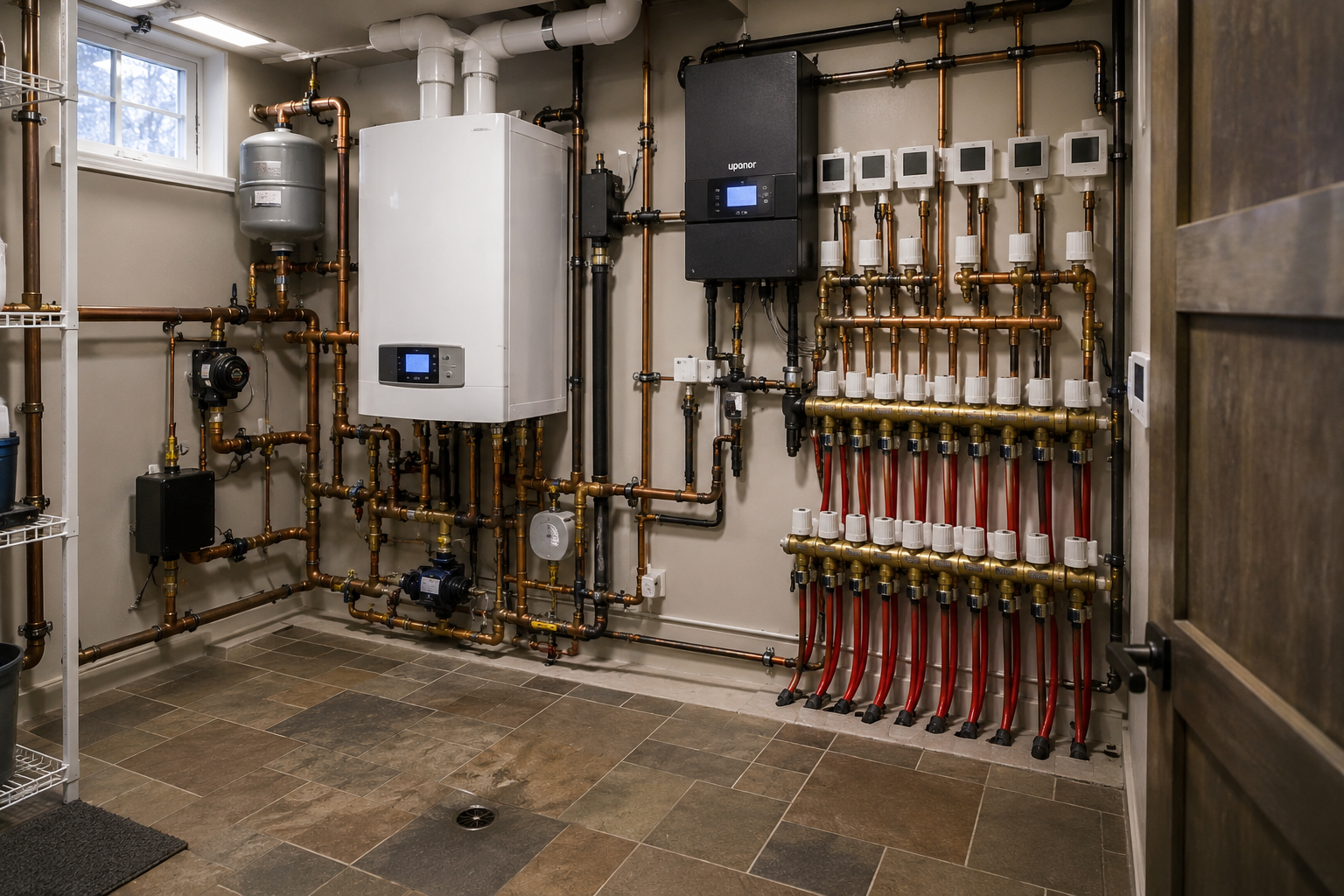
The boiler is the central heat source for most hydronic systems, but it is only one part of the installation. A luxury-home mechanical room may contain circulation pumps, zone valves, mixing valves, expansion tanks, air separators, pressure controls, manifolds, gauges, and extensive networks of piping.
Each component serves a different purpose:
Circulation pumps move heated water through the system. Zone valves or manifold actuators control which areas receive flow. Expansion tanks accommodate changes in water volume as the system heats and cools. Air separators help remove trapped air that can interfere with circulation.
Mixing valves are particularly important in systems containing different types of heat emitters.
Radiant floors often require lower water temperatures than conventional radiators or hydronic baseboards. A mixing valve can blend cooler return water with hotter boiler water before sending it through the floor tubing. Without proper temperature control, flooring materials can become excessively warm or experience unnecessary stress. Water that is too cool, on the other hand, may not provide adequate heat. The mechanical room may look orderly and sophisticated while still containing an inactive pump, leaking valve, incorrect control setting, or poorly identified piping connection. Understanding the flow of water through the system is an important part of evaluating it.
Radiant Heating Zones and Controls
Large hydronic systems are usually divided into zones. A zone may represent one room, one floor, a bathroom group, a bedroom wing, or another section of the property. Each zone typically has its own thermostat or temperature control.
When a thermostat requests heat, it may activate a dedicated circulation pump or open an actuator at a manifold. The boiler then operates as needed to supply heated water.
Luxury homes may contain many thermostats, but not every thermostat controls the same type of system. One may control a forced-air furnace while another controls a radiant-floor loop. Additional controls may operate garage heat, towel warmers, snowmelt equipment, or a hydronic air handler.
Some radiant systems also use floor-temperature sensors. These sensors may limit the maximum floor temperature or maintain a warm floor even when the room thermostat is satisfied. This is particularly common in bathrooms, where the system may be intended as much for floor comfort as for heating the room.
More sophisticated hydronic systems may also use an outdoor-reset control. Rather than maintaining one fixed supply-water temperature throughout the heating season, the control adjusts the target water temperature based on outdoor conditions. On a relatively mild Denver winter day, the system may circulate cooler water than it would during a prolonged cold period.
Outdoor reset can improve comfort and boiler efficiency, particularly with low-temperature radiant floors, but it also means a buyer should not expect the boiler to operate at one constant temperature. A changing supply-water temperature may be normal when the control is responding to outdoor conditions.
Control problems can be difficult to recognize because the boiler may still operate normally. A failed actuator, disconnected sensor, stuck zone valve, or inoperative circulation pump may affect only one portion of the home. The system can therefore appear functional even when one or more zones are not receiving heat.
Why Radiant Systems Respond Slowly
Radiant-floor heating generally changes room temperature more slowly than forced-air heating. The system must first heat the water, tubing, and floor assembly. The floor then releases that heat into the room. In concrete systems, this process may take a considerable amount of time.
The same thermal mass that creates slow response also provides one of the system’s advantages. Once warm, the floor can maintain stable conditions and continue releasing heat after the boiler shuts off.
Problems can arise when occupants operate radiant heat like a forced-air furnace. Large thermostat setbacks may allow the floor to cool significantly. When the thermostat is raised again, the system may need hours to restore the desired temperature. This can lead homeowners to believe the system is underperforming when it is actually responding according to its design.
Control programming should account for this slower behavior.
During an inspection, radiant systems should be given enough time to respond. A brief thermostat adjustment may activate a pump or valve, but it may not create an immediate or obvious temperature change at the floor surface.
Flooring Materials and Heat Transfer
The finished floor affects how radiant heat reaches the room. Tile, stone, and concrete generally transfer heat effectively. These materials are common above radiant systems because they conduct heat well and tolerate temperature changes when properly installed. Carpet, thick padding, and certain wood-flooring assemblies can reduce heat transfer.
Wood products also expand and contract as temperature and moisture conditions change. Excessive floor temperatures or rapid changes can contribute to gaps, movement, cupping, or other flooring concerns. This does not mean wood flooring is incompatible with radiant heat. Many wood floors perform well over properly designed systems. The flooring type, installation method, water temperature, indoor humidity, and manufacturer requirements all matter.
Many wood-flooring manufacturers also publish maximum allowable surface temperatures for radiant applications. Those limits vary by product, so the flooring manufacturer’s requirements are more useful than applying one universal temperature limit to every wood floor.
Area rugs can also affect floor temperatures. A thick rug or furniture placed over a radiant slab can trap heat and change how the floor performs in that area.
When visible flooring concerns are present, the heating system should be considered as one possible contributing factor rather than evaluated in isolation.
Common Hydronic Heating Concerns
Hydronic systems can continue operating despite localized defects.
A small leak may evaporate before creating obvious standing water. A pump may become noisy but continue moving some water. Air trapped within a loop may reduce heat without stopping circulation completely.
Common concerns include corrosion at valves and fittings, leaking pumps, failed actuators, damaged pipe insulation, noisy circulation, inaccurate gauges, poorly supported piping, and evidence of previous leakage.
Uneven heat is another frequent concern. One room may warm normally while an adjacent zone remains cool. The cause could be a control problem, trapped air, a closed valve, an inactive pump, restricted flow, or a damaged floor sensor.
Some systems receive makeup water automatically when pressure drops. While this can keep the system operating, frequent water addition may introduce oxygen and minerals that contribute to internal corrosion. Regular pressure loss may also indicate leakage that deserves attention.
A boiler and piping system should not require repeated refilling under normal conditions.
Highly zoned hydronic systems can also experience short-cycling when only a very small zone is requesting heat. If a bathroom or other small radiant zone creates less demand than the boiler can efficiently supply at its minimum firing rate, the boiler may repeatedly fire and shut down rather than operate for a longer cycle.
Some systems use buffer tanks, control strategies, or additional thermal mass to reduce this cycling. Frequent short cycles can increase component wear and may indicate that the relationship between boiler output, zoning, and controls deserves closer evaluation.
Tubing Materials and Oxygen Diffusion
Radiant tubing from different generations is not necessarily equivalent. Modern hydronic PEX commonly includes an oxygen-diffusion barrier designed to limit oxygen migration through the tubing wall. Some older plastic tubing installations may not provide the same protection.
In a closed hydronic system, continued oxygen entry can contribute to corrosion of ferrous components such as cast-iron circulators, steel piping, and some boiler heat exchangers. When older tubing remains in service, the materials used elsewhere in the system—and whether the radiant loops are isolated from vulnerable components—can be important to understanding the installation. The presence of older tubing does not by itself establish a defect, but it can make corrosion history and system design more relevant.
Leaks and Concealed Tubing
Most radiant-floor tubing is concealed beneath finished surfaces. Modern tubing materials are generally durable when properly installed, but concealed piping still creates uncertainty when leakage is suspected.
Possible signs include:
• Unexplained pressure loss
• Repeated boiler refilling
• Localized flooring damage
• Moisture staining
• Warm or cool areas that do not match the expected loop pattern
• A zone that no longer heats properly
Not every temperature variation indicates a leaking or damaged loop. Tubing spacing, furniture, rugs, floor thickness, sunlight, and nearby ductwork can all affect surface temperatures.
This is why interpretation matters. A cool stripe in a thermal image may represent normal tubing spacing or an inactive loop. A warm area may come from sunlight or another concealed heat source. The pattern should be considered alongside system operation, room conditions, and visible mechanical components.
Thermal Imaging and Radiant Floors
Thermal imaging can be especially useful when evaluating radiant-floor systems. When the system has operated long enough and the temperature difference is adequate, a thermal camera may reveal the path of tubing beneath the floor. It can also show whether a zone is warming evenly or whether portions appear inactive.
The usefulness of thermal imaging depends on conditions.
Thick flooring, concrete mass, carpeting, solar exposure, furniture, and recent thermostat changes can affect the image. Tubing may also remain warm after the thermostat is satisfied, making it difficult to determine whether the zone is currently active.
Warm-weather inspections can be particularly limiting. If the floor surface is already warm from indoor conditions or solar gain, active tubing may not create enough surface-temperature contrast to reveal a clear loop pattern even when the system is functioning.
Thermal imaging should therefore be used as an additional diagnostic tool rather than treated as a simple pass-or-fail test. In the hands of an experienced inspector, the pattern can provide valuable information about system operation and help identify areas that deserve closer attention.
Condensing Boilers and Drainage
Many modern luxury homes use high-efficiency condensing boilers. These boilers extract additional heat from combustion gases, improving efficiency. During operation, they also produce condensate that must be collected and drained properly. Visible concerns may include leaking condensate piping, blocked drains, damaged neutralization equipment, corrosion, or improper termination.
The venting system also differs from that of many older boilers. High-efficiency equipment commonly uses dedicated intake and exhaust piping rather than relying on a traditional masonry chimney.
When an older boiler is replaced with high-efficiency equipment, the surrounding system may not be fully modernized. Older pumps, controls, distribution piping, or domestic water-heating equipment may remain. This type of partial modernization can be encountered in established Denver luxury neighborhoods such as Country Club and Hilltop, where homes may have gone through several generations of renovation without every hydronic component being replaced at the same time.
As with other complex systems, a newer boiler does not necessarily mean the complete hydronic installation is new.
Domestic Hot Water and Combination Systems
Some boilers provide both space heating and domestic hot water. This may be accomplished through a combination boiler or an indirect water heater connected to the boiler system. An indirect water heater uses boiler water to heat the potable water stored inside a separate tank.
These arrangements can be efficient and reduce the number of separate fuel-burning appliances in the home. They also make the boiler important throughout the entire year.
A boiler problem may affect both room heating and the home’s hot-water supply. The controls must prioritize demand appropriately. When the indirect water heater calls for heat, the system may temporarily direct boiler output toward domestic hot water before returning to the radiant zones. Understanding these relationships helps explain why pumps and valves may operate even when no room thermostat appears to be calling for heat.
Snowmelt and Exterior Hydronic Systems
Luxury properties may use hydronic tubing beneath driveways, walkways, patios, or exterior stairs to melt snow and ice. These systems are more likely to be encountered on larger properties with extensive exterior hardscape, including estate homes in Greenwood Village or foothill properties around Genesee where long or sloped drives can make snow and ice management more involved.
These systems may connect to the main boiler installation or use dedicated equipment. Snowmelt systems operate differently from indoor radiant floors. They must deliver enough energy to warm an exterior surface while outdoor temperatures are low and snow is actively falling.
Controls may use slab sensors, outdoor-temperature sensors, or moisture detection to activate the system automatically.
Snowmelt equipment can place a substantial demand on the boiler. It may also use a water and antifreeze mixture to reduce freeze risk.
The presence of snowmelt adds another layer of piping, pumps, controls, and maintenance. Buyers should understand whether the system is operational, how it is controlled, and whether it shares equipment with the home’s interior heating system.
Why This Topic Is Difficult for a Novice or Intermediate Home Inspector
Radiant-floor and hydronic systems can be difficult to evaluate because much of the distribution system is concealed.
In a forced-air home, an inspector can often follow visible ducts and feel airflow at supply registers. In a radiant system, the tubing may disappear beneath concrete or finished flooring immediately after leaving the mechanical room.
The inspector must understand the piping arrangement and identify which pumps, valves, manifolds, and thermostats serve each area. This can be challenging in a luxury home with several boilers, multiple manifolds, overlapping heating systems, and extensive control wiring.
A less-experienced inspector may confirm that the boiler ignites and assume the system is operating properly. That does not establish that water is circulating through every zone or that each floor loop is producing heat.
Experience is also important when interpreting thermal patterns. An inactive-looking area could result from a failed zone, but it could also reflect system timing, floor construction, thermostat programming, solar gain, or normal loop spacing. Drawing the wrong conclusion can either overlook a real problem or create unnecessary concern.
The inspection requires patience because radiant systems respond slowly. Thermostats and zones should be operated methodically so the inspector can observe which pumps, valves, and floor areas respond.
The goal is not simply to identify a boiler. The goal is to understand how heat is generated, distributed, controlled, and delivered throughout the property.
What an Experienced Inspector Evaluates
A thorough inspection begins with identifying the boilers, distribution components, thermostats, manifolds, and apparent heating zones.
Accessible pumps, valves, expansion tanks, gauges, piping connections, and controls should be evaluated for visible leakage, corrosion, damage, or unusual operation. The inspector should also review boiler venting, combustion-air provisions, condensate drainage, and surrounding mechanical-room conditions.
Thermostats should be operated individually where possible so the corresponding pumps, valves, or actuators can be observed.
When conditions allow, thermal imaging can help determine whether floor areas are warming and whether the patterns are generally consistent with active radiant loops.
The building should also be considered. Flooring materials, room exposure, insulation, large windows, ceiling height, and other heating systems all affect comfort. In a large custom home in Cherry Hills Village or Castle Pines Village, for example, a room with extensive glass or a high ceiling may behave very differently from an interior bathroom served by the same boiler system. A cool room does not automatically mean the boiler has failed, just as an operating boiler does not confirm that every room is being heated effectively.
This complete-system approach is especially important in luxury properties where radiant heat may overlap with forced-air furnaces, fireplaces, mini-splits, and specialty systems.
Why Maintenance Records Matter
Hydronic heating systems benefit from consistent professional maintenance. Records can help clarify the age of the boiler, whether pumps or valves have been replaced, and whether the system has experienced recurring pressure loss or control problems. Service records may also identify water-treatment history, antifreeze maintenance, boiler cleaning, combustion service, and repairs to individual zones.
Some hydronic systems use inhibited propylene glycol rather than water alone, particularly where piping, slabs, garages, or other portions of the system could be exposed to freezing conditions. When glycol is present, its concentration and condition become part of long-term maintenance because freeze protection and corrosion inhibitors can degrade over time.
Service records may indicate whether the fluid has been tested for freeze protection, pH, or inhibitor condition and whether it has been replaced or adjusted. This can be especially relevant in foothill properties, second homes, or large estates that may be unoccupied for extended periods during winter.
For buyers, maintenance history is valuable because many hydronic systems contain components from different periods. A newer boiler may be connected to older pumps, manifolds, or concealed tubing. The condition of the complete system matters more than the age of one component.
Inspector Insight
One of the most common misunderstandings with radiant-floor heating is assuming that a warm boiler means the floors are working. The boiler can operate normally while an individual circulation pump, zone valve, manifold actuator, or thermostat fails to respond. Because the tubing is concealed, the affected zone may not show an obvious mechanical defect.
Another common issue is unrealistic response expectations. Radiant systems, particularly those embedded in concrete, do not respond like forced-air furnaces. Raising the thermostat for a few minutes may activate the system without creating an immediate change at the floor.
This is where a methodical inspection and thermal imaging can be useful. The inspector can observe which controls respond, whether circulation equipment activates, and whether heat patterns begin developing in the expected areas.
The system should be evaluated as a network of connected components rather than as a single boiler in the mechanical room.
Practical Implications for Homeowners and Buyers
Homeowners should keep thermostats and heating zones clearly labeled. The mechanical room should remain accessible, and any signs of leakage, pressure loss, unusual pump noise, or inconsistent floor temperatures should be addressed before they become larger problems.
Large thermostat setbacks are often less effective with high-mass radiant systems. Stable settings may provide better comfort and reduce the long recovery periods associated with reheating a cold slab.
For buyers, it is important to understand which areas of the home have radiant heat and whether it serves as the primary or supplemental heat source. Buyers should also determine whether the system provides domestic hot water, serves exterior snowmelt areas, or shares equipment with other hydronic components. The number and age of boilers, pumps, controls, and heating zones should be considered when planning future maintenance and replacement costs.
For agents, radiant heating findings should be explained in context. A slow response is not automatically a defect, and one inactive zone does not necessarily mean the entire system requires replacement.
The purpose of the inspection is to understand how the system is configured, identify visible or operational concerns, and help the buyer make informed decisions about a complex feature of the property.
The Bottom Line
Radiant-floor and hydronic heating systems can provide exceptional comfort in Denver-area luxury homes, but they require a more thoughtful inspection approach than simply confirming that the boiler operates.
A complete system may include numerous pumps, valves, manifolds, thermostats, sensors, and concealed floor loops. One component can fail while the rest of the system continues to appear functional.
An experienced inspector should evaluate the accessible mechanical components, operate individual zones, observe the relationship between controls and equipment, use thermal imaging when conditions are appropriate, and consider how the heating system interacts with the flooring and building enclosure.
For buyers, the most important question is not simply whether the home has radiant heat.
The more important question is whether the complete hydronic system is understandable, properly maintained, and delivering heat to the property as intended.
Author
Andrew Sams is the founder of Alpine Building Performance, a Denver based residential and commercial inspection firm. He holds a B.S. in Building Science and has over 15 years of experience in building diagnostics, energy auditing, and property condition assessment.
Andrew is a Certified Master Inspector (CMI), Certified Commercial Property Inspector (CCPI), and Radon Measurement Specialist. He was named the Denver Metro Association of Realtors 2022 Industry Partner of the Year and teaches continuing education courses for real estate professionals throughout Colorado.