Attic Moisture and Ice Damming Along the Front Range: What Causes It and Why It Matters
Why Ice Dams and Attic Moisture Are So Common in Colorado
Along the Front Range, attic moisture and ice damming show up in a wide range of homes, from early 1900s bungalows to newer construction. The issue is not tied to one specific era or roof type. It is driven by how buildings interact with Colorado’s winter climate.
Snowfall, solar gain, and fluctuating temperatures create conditions where parts of a roof warm up while others remain frozen. When combined with indoor air leaking into the attic, the result is a pattern of melting, refreezing, and trapped moisture.
In many cases, what looks like a roofing problem is actually a building performance issue. The roof is where the symptom appears, but the cause usually starts inside the home.
Why the Front Range Climate Drives Ice Dam Formation
Colorado’s climate plays a direct role in how and why ice dams form. Unlike consistently cold regions, the Front Range often cycles between sunny, relatively warm days and freezing nights.
A typical winter pattern looks like this:
Snow accumulates across the roof surface
Sun exposure and indoor heat warm the upper roof areas
Snow begins to melt and flow downward
Roof edges and eaves remain cold and refreeze the water
This cycle can repeat daily for extended periods. Each cycle adds more ice at the roof edge, gradually building a dam that blocks proper drainage.
Colorado's high solar radiation makes this dynamic particularly pronounced. Even on cold days, a south- or west-facing roof can reach surface temperatures well above freezing through sun exposure alone (independent of how much heat is escaping from below). This means ice dam conditions can develop even on roofs that are reasonably well insulated, and it distinguishes Front Range ice dam behavior from that seen in consistently cold climates like the Midwest or Northeast where solar gain is a lesser factor.
What an Ice Dam Actually Is
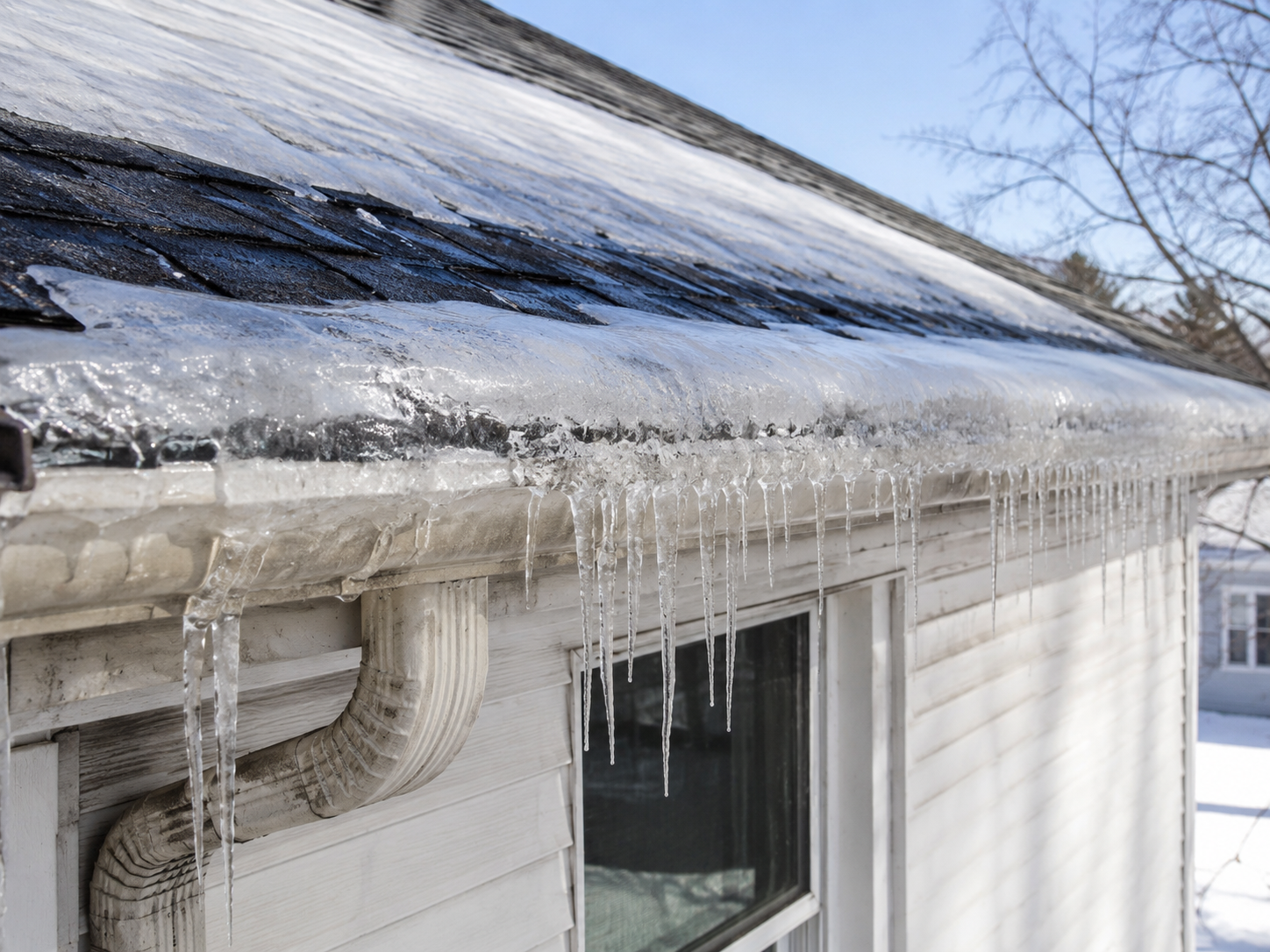
An ice dam forms when melted snow refreezes at the colder edge of a roof, typically near the eaves. Over time, this ice buildup creates a barrier that prevents additional meltwater from draining off the roof.
The reason ice consistently forms at the eaves rather than higher on the roof comes down to one structural fact: eaves extend beyond the insulated building envelope. There is no heated living space below them to contribute warmth, so they remain at or near the outdoor air temperature while the upper roof, which sits above conditioned space, is warmer. That temperature difference is where the freeze-thaw boundary forms, and where ice accumulates. An important distinction is that ice dams are usually not caused by roofing failure alone. In most cases, they indicate uneven roof temperatures driven by heat loss from the home.
Where Attic Moisture Really Comes From
A common assumption is that attic moisture originates from outside conditions. In reality, most of the moisture begins inside the home.
Everyday activities generate water vapor:
Cooking
Showering
Breathing
Laundry
Humidification
Warm air holds moisture. As that air rises and escapes into the attic, it encounters colder surfaces. When temperatures drop, the moisture condenses on framing members and roof sheathing.
Over time, this repeated condensation can lead to frost buildup in winter and liquid water during warmer periods.
How Warm Air Gets Into the Attic
Air leakage is the primary driver behind both attic moisture and ice damming. Small openings in the building envelope allow a surprising amount of air to move upward into the attic.
Common leakage points include:
Gaps around attic access hatches
Recessed lighting fixtures
Electrical and wiring penetrations
Plumbing vent openings
Bath fan housings and duct connections
Wall top plates
Bath fans deserve particular attention. A fan housing that is poorly sealed is a leakage point, but an equally common (and more serious) condition is a bath fan that vents directly into the attic rather than to the exterior. This introduces warm, moisture-laden air from the most humid room in the home directly into the attic space, often continuously. It is one of the more consistent moisture problems found in Front Range inspections and should be confirmed as part of any attic evaluation.
These openings may seem minor, but collectively they can allow significant heat and moisture to escape. In many homes, air leakage has a greater impact than insulation levels alone.
What Inspectors Commonly Observe
The signs of attic moisture and ice damming often appear in stages and may not all be visible at the same time.
During winter, exterior indicators may include:
Icicles forming along roof edges
Uneven snow melt patterns
Frost accumulation in the attic
Inside the home, early warning signs can include:
Ceiling staining near exterior walls
Peeling paint at upper levels
Localized mold growth
By spring, the evidence often shifts to:
Damp or compressed insulation
Staining on roof sheathing
Musty odors in attic spaces
These conditions can develop gradually, which is why they are sometimes overlooked until damage becomes more apparent.
Why Ventilation Alone Is Not the Solution
A common response to ice damming is to add more roof ventilation. While ventilation plays an important role, it does not address the primary cause.
Ventilation helps remove moisture and moderate attic temperatures after air has already entered the space. It does not stop warm, moist air from getting there in the first place.
A properly functioning attic relies on three components working together:
Air sealing to limit heat and moisture entry
Insulation to reduce heat loss
Ventilation to manage residual moisture and temperature
Focusing on ventilation alone often leads to incomplete or short-term improvements.
Why Even Newer Homes Experience Ice Dams
Ice damming is not limited to older homes. Newer construction along the Front Range can experience the same issues, sometimes for different reasons.
Contributing factors in newer homes may include:
Complex roof designs with valleys and transitions
Inconsistent insulation coverage
Newer homes are often built with tighter envelopes than older construction, which is generally beneficial. However, tighter construction also traps more indoor moisture if mechanical ventilation is not adequate to compensate. Homes without a properly sized and functioning heat recovery ventilator (HRV) or energy recovery ventilator (ERV) can accumulate elevated indoor humidity levels that increase the moisture load reaching the attic through any remaining leakage points. Tighter is not always drier without the ventilation system to match.
Potential Damage From Ongoing Moisture
When attic moisture persists over multiple seasons, it can affect several parts of the home.
Common impacts include:
Wood rot in roof framing
Mold growth on sheathing and insulation
Reduced insulation effectiveness
Ceiling and drywall damage
Premature deterioration of roofing materials
In addition, repeated ice damming can loosen or damage shingles, increasing the likelihood of water intrusion over time.
Prevention Starts With Temperature Control
Long-term prevention focuses on controlling heat flow and air movement rather than reacting to symptoms.
Effective strategies generally include:
Limiting warm air leakage into the attic
Maintaining consistent and complete insulation coverage
Supporting balanced attic ventilation
For Colorado's climate zones, the U.S. Department of Energy recommends attic insulation levels of R-49 to R-60. Many older Front Range homes fall well below this range, and even newer homes sometimes have incomplete coverage at eaves, around framing members, or at transitions between conditioned and unconditioned spaces. Insulation levels alone are not sufficient if air sealing is inadequate, but knowing the target gives homeowners and buyers a practical benchmark when evaluating attic performance.
Temporary measures such as removing snow from the roof or installing heat cables may reduce immediate symptoms, but they do not correct the underlying imbalance. Heat cables in particular carry ongoing electricity costs and require annual maintenance and inspection to remain functional, which can make them a less-than-ideal long-term solution.
One roofing component worth verifying in older homes is the presence of an ice and water shield (a self-adhering waterproof membrane installed under shingles at the eaves). This membrane is specifically designed to prevent water that backs up behind an ice dam from penetrating the roof assembly. It is required by code in cold climates for new construction and re-roofing, but many older Denver-area roofs predate that requirement. Its absence does not mean immediate failure, but it does mean the roof has less protection if an ice dam forms and water backs up.
Inspector Insight
In Front Range inspections, ice damming is often misunderstood as a roof problem. In reality, many of the roofs involved are in serviceable condition. The consistent factor is uneven attic temperature caused by air leakage.
One of the more telling observations is frost buildup on roof sheathing during winter. This indicates that warm, moisture-laden air is reaching the attic and condensing. When that frost melts, it can create moisture conditions that look like a roof leak from below.
Another common pattern is localized problem areas. A home may have one section of roof with heavy ice buildup while another section remains clear. This usually corresponds to differences in insulation coverage or air leakage pathways, not differences in roofing materials.
These patterns reinforce that the issue is driven by how the home performs as a system.
Practical Implications
For buyers, evidence of ice damming or attic moisture should prompt a closer look at insulation and air sealing rather than focusing only on the roof covering. The visible symptoms often point to hidden performance issues.
For homeowners, recurring ice dams are a signal that heat is escaping the home unevenly. Addressing that heat loss can improve comfort, reduce energy use, and limit moisture-related damage.
For agents, these conditions can influence both inspection findings and future maintenance expectations. Helping clients understand the cause behind the issue leads to more informed decisions and realistic planning.
In most cases, the solution is not a single repair but a coordinated approach to how the attic is managed.
Author
Andrew Sams is the founder of Alpine Building Performance, a Denver based residential and commercial inspection firm. He holds a B.S. in Building Science and has over 15 years of experience in building diagnostics, energy auditing, and property condition assessment.
Andrew is a Certified Master Inspector (CMI), Certified Commercial Property Inspector (CCPI), and Radon Measurement Specialist. He was named the Denver Metro Association of Realtors 2022 Industry Partner of the Year and teaches continuing education courses for real estate professionals throughout Colorado.