
Basement Wall Cracks in Denver Homes: Cosmetic or Structural?
Why Basement Wall Cracks Are So Common in Denver
Basement wall cracks are one of the most frequent concerns noted during home inspections along the Front Range. In many cases, they are expected. The underlying reason is not poor construction, but soil behavior.
Much of the Denver area is built on expansive clay soils. These soils change volume as moisture levels fluctuate. When wet, they expand and press against foundation walls. When dry, they shrink and can allow portions of the structure to settle.
This constant cycle of expansion and contraction places stress on basement walls. Over time, that stress often shows up as cracking. The presence of a crack alone is not unusual. What matters is how the crack formed, where it is located, and whether it is changing.
How Colorado Soil Conditions Affect Foundations
Along the Front Range, soil movement is an ongoing process rather than a one-time event.
Typical forces acting on foundations include:
Expansion of wet soils pushing inward against walls
Shrinkage during dry periods allowing settlement
Freeze-thaw cycles adding seasonal movement
Because basements extend below grade into active soil zones, they are directly exposed to these forces. Even well-constructed foundations can develop cracking as part of normal movement over time.
Foundations must extend below the frost line to avoid frost heave, a separate movement mechanism from expansive soil behavior. In the Denver area, the frost depth is generally around 36 inches. Older homes with shallow footings can experience frost heave as an independent source of foundation movement, and this is worth considering when evaluating cracking patterns in structures built before modern code requirements were established.
Types of Basement Foundations and How They Respond
Not all foundation walls behave the same way. The material and construction method influence how cracks develop and how the structure responds to soil pressure.
Poured Concrete Walls
Common in newer homes, these walls are relatively strong and resist water penetration well. They often develop vertical shrinkage cracks as the concrete cures or as the structure settles slightly.
The water resistance of a poured concrete wall depends significantly on mix quality, curing conditions, and the presence of any applied waterproofing. Assuming a poured wall is dry simply because it is poured concrete is not reliable. Moisture evaluation should be based on observed conditions rather than wall type alone.
Concrete Block (CMU) Walls
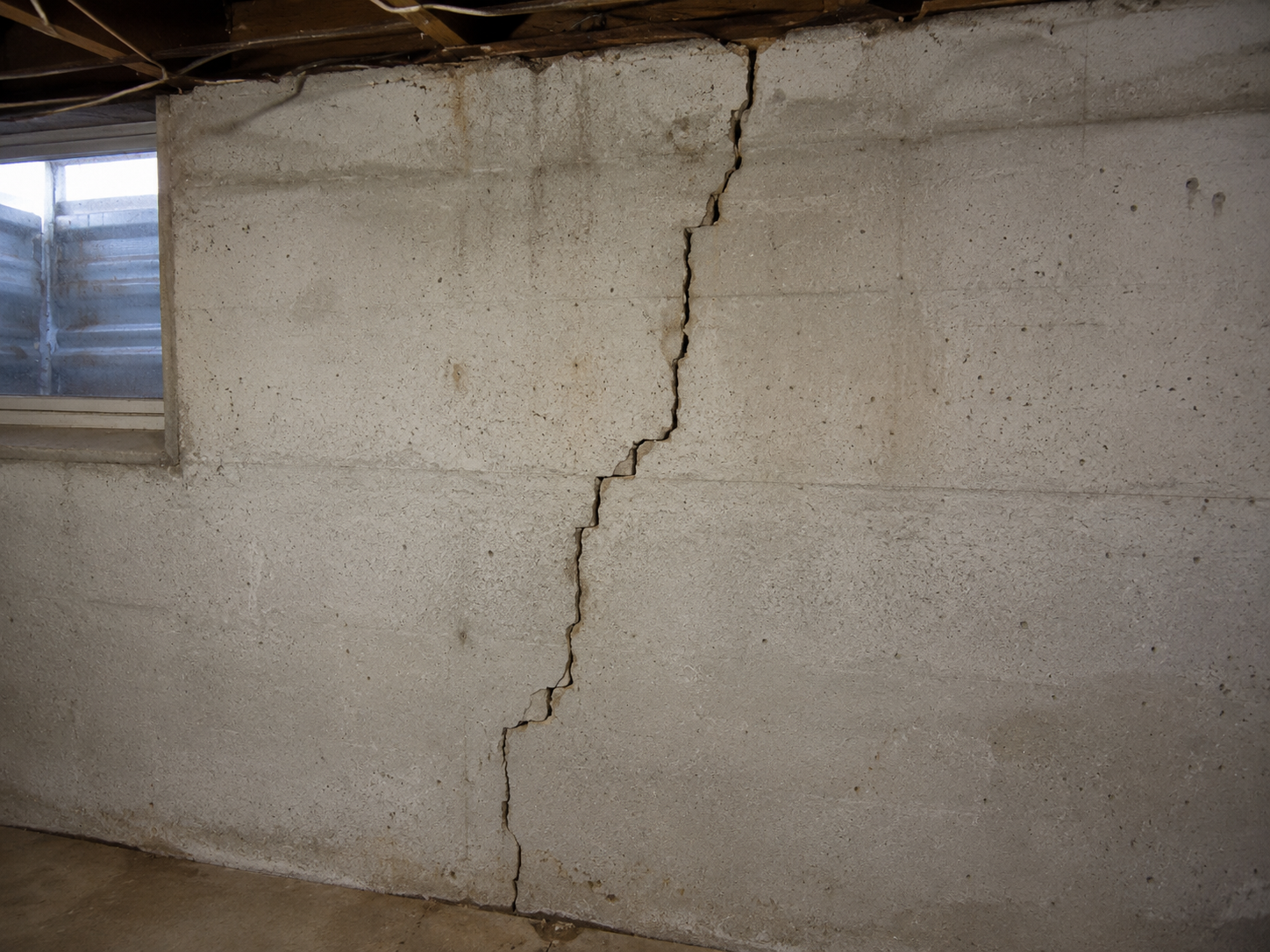
These walls are more flexible but also more susceptible to lateral pressure. Cracking often follows mortar joints in a stair-step pattern when movement occurs.
Brick or Stone Foundations
Typically found in older homes, these materials are more porous and can be more affected by moisture intrusion. Movement often appears as irregular cracking patterns.
Understanding the wall type helps interpret what a given crack may indicate.
Common Crack Types That Are Typically Cosmetic
Many cracks observed in Denver basements fall into the category of expected or non-structural movement.
Vertical Shrinkage Cracks
These are usually narrow, relatively straight, and commonly found in poured concrete walls. They often form as the concrete cures or as minor settlement occurs.
Short Cracks Near Window Corners
Basement windows create natural stress points in the wall. Small cracks extending from these corners are common as materials adjust over time.
Hairline Cracks
Fine cracks can appear in most foundations. On their own, they rarely indicate structural problems.
A practical benchmark used in field evaluations is that cracks narrower than 1/4 inch that show no displacement and remain stable over time are generally lower concern. Cracks at or wider than 1/4 inch, or any crack showing horizontal displacement between sections of wall, warrant professional evaluation regardless of pattern. Tracking crack progression over time is straightforward: mark each end with a pencil, note the date, and re-check periodically. If the marks move apart, the crack is active.
In these cases, monitoring is typically more appropriate than immediate repair. The key is confirming that the cracks remain stable.
Crack Patterns That May Indicate Structural Movement
Certain crack types warrant closer attention because they suggest ongoing or uneven forces acting on the foundation.
Horizontal Cracks
Often associated with soil pressure pushing inward. These can be an early indicator of wall movement and may precede bowing.
Horizontal cracks are among the more serious patterns found in basement walls and deserve a clear explanation of why. When lateral soil pressure pushes against the outside of a wall, the wall behaves like a beam being bent. Tension develops on the interior face, and if that tension exceeds what the material can handle, a horizontal crack opens. This is a fundamentally different mechanism from shrinkage or settlement cracking. Left unaddressed, the wall can continue to deflect inward over time, eventually compromising the structural connection between the foundation and the floor framing above. Any horizontal crack, particularly in a block or poured concrete wall, should be evaluated by a structural engineer rather than monitored and deferred.
Stair-Step Cracks in Block or Brick Walls
These follow mortar joints and typically indicate differential movement within the wall system.
Long Diagonal Cracks
Cracks that run at an angle across a wall can suggest uneven settlement affecting different portions of the foundation.
Widening Cracks
Any crack that continues to change over time indicates that movement is ongoing.
The pattern and progression of these cracks are more important than their width at any single point in time.
Bowing or Leaning Walls: A More Significant Indicator
In some cases, soil pressure does more than create cracks. It can cause the wall itself to move.
Signs of potential wall movement include:
Inward curvature or bowing of basement walls
Separation between the wall and floor framing above
Doors or windows on upper levels beginning to stick
Inward movement is typically associated with lateral soil pressure. Outward movement at the base of a wall is less common and can indicate floor slab heave pushing the wall base outward or inadequate footing support, either of which warrants structural evaluation.
When bowing walls are present, two repair approaches are commonly used in Denver-area homes. Carbon fiber strap systems are bonded vertically to the interior wall surface to resist further inward movement. They are effective when deflection is limited and the wall has not moved significantly. Steel I-beam systems are anchored to the floor and the floor framing above and can provide more substantial resistance where deflection is more advanced. Buyers evaluating a home with existing wall repairs should confirm what system was installed, when it was done, and whether it was installed by a licensed contractor with a transferable warranty.
The Role of Moisture Around the Foundation
Water plays a major role in how soils behave and how much pressure they place on foundation walls.
Common moisture-related indicators include:
Damp or wet basement walls
White mineral deposits (efflorescence)
Musty odors or mold growth
Seasonal changes in moisture levels
Poor drainage around the home often contributes to increased soil expansion. In many cases, moisture management has a greater impact on foundation performance than the age of the structure itself.
Colorado-Specific Soil Conditions Worth Knowing
In addition to expansive clay, some Front Range soils contain pyrite or sulfate minerals. When these minerals are exposed to moisture over time, they can cause a chemical reaction that leads to concrete floor slabs heaving upward from below. This mechanism is distinct from expansive clay movement and can be mistaken for differential settlement or other structural issues. It is not present across all Denver-area neighborhoods, but it is a known condition in certain locations and worth considering when floor heave is observed without a clear drainage or moisture explanation.
Basement Cracks and Radon Entry
Colorado has some of the highest residential radon levels in the country, and basement wall cracks are one of the primary pathways through which radon gas enters a home. Radon is a naturally occurring radioactive gas that moves upward through soil and enters through any opening at or below grade, including foundation wall cracks, floor slab cracks, and gaps at the wall-floor joint.
This connection matters for two reasons. First, sealing foundation cracks as part of routine maintenance is not just a moisture or structural consideration; it also reduces radon entry points. Second, buyers purchasing a home with significant foundation cracking should treat radon testing as a standard part of the inspection process, not an optional add-on. Mitigation systems are effective and relatively affordable, but knowing the radon level before closing allows for informed decisions about remediation.
Differential Settlement and Its Effects Above the Basement
Not all parts of a foundation move uniformly. When one section settles more than another, the result is differential movement.
This can affect the structure above the basement, leading to:
Sloping or uneven floors
Cracks in drywall on upper levels
Misaligned doors and windows
These symptoms provide additional context when evaluating foundation conditions. They help determine whether movement is localized or affecting the structure more broadly.
When Monitoring Is the Right Approach
In many homes, cracks can be observed and tracked over time without immediate structural intervention.
Monitoring is often appropriate when:
Cracks remain consistent in size
No visible displacement is present
Doors and windows operate normally
Seasonal movement is minimal
Documenting crack width and length periodically can help determine whether conditions are stable.
When Further Evaluation Is Recommended
Certain conditions suggest that a more detailed structural assessment is warranted.
These include:
Cracks that continue to widen
Horizontal displacement between sections of a wall
Noticeable bowing or leaning
Persistent or increasing water intrusion
Significant changes in floor level or alignment
Further evaluation does not automatically mean major repair is required. It provides clarity on whether the structure is stable and what, if any, corrective measures are appropriate.
Managing Soil Moisture to Reduce Movement
Long-term foundation performance is closely tied to how moisture is managed around the home.
Key strategies include:
Maintaining positive grading away from the foundation
Directing roof runoff away using gutters and downspouts
Avoiding extreme cycles of overwatering or prolonged dryness near the foundation
Interestingly, completely dry soil is not always the goal. Consistency is more important than extremes. Stable moisture levels help reduce expansion and contraction cycles.
Inspector Insight
In Denver-area inspections, most basement wall cracks fall into the category of expected movement. Vertical cracks in poured concrete are especially common and are often stable over time.
What tends to raise concern is not the presence of cracking, but the pattern. Horizontal cracks or stair-step cracking in block walls are more likely to reflect ongoing soil pressure. These conditions often correlate with drainage issues or concentrated moisture near the foundation.
Another common observation is that homeowners are often more concerned about visible cracks than subtle movement. In practice, slight wall bowing or floor slope changes can be more meaningful indicators of structural behavior than a narrow crack.
Evaluating the full context of the home is what leads to the most accurate assessment.
Practical Implications
For buyers, basement cracks should be evaluated carefully but not overinterpreted. Many homes remain structurally sound despite visible cracking. The goal is to understand whether movement is ongoing and whether it affects the overall structure.
For homeowners, managing drainage and soil moisture can significantly reduce future movement. Small improvements in water control often have a measurable impact over time.
For agents, foundation cracks are a common point of concern during transactions. Providing context around typical versus concerning patterns helps keep negotiations grounded in actual risk rather than assumption.
In most cases, cracks are part of how foundations respond to their environment. The key is distinguishing between normal behavior and conditions that require further attention.
Author
Andrew Sams is the founder of Alpine Building Performance, a Denver based residential and commercial inspection firm. He holds a B.S. in Building Science and has over 15 years of experience in building diagnostics, energy auditing, and property condition assessment.
Andrew is a Certified Master Inspector (CMI), Certified Commercial Property Inspector (CCPI), and Radon Measurement Specialist. He was named the Denver Metro Association of Realtors 2022 Industry Partner of the Year and teaches continuing education courses for real estate professionals throughout Colorado.