
Why Expansive Clay Soils Cause Foundation Movement in Denver Metro Homes
Foundation movement is one of the most common concerns reported during home inspections in the Denver metro area. In many cases, the cause is not construction defects or aging materials. It is the soil beneath the home.
Much of the Front Range sits on clay rich soils with expansive properties. These soils change volume significantly as moisture levels fluctuate. When wet, they swell. When dry, they shrink. Over time, that expansion and contraction places pressure on foundations, basement walls, slabs, crawlspaces, and framing systems.
Expansive clay soils are widely documented throughout the Colorado Front Range and are a primary reason foundation movement is commonly observed during home inspections in the Denver metro area.
Because this process repeats seasonally, many Denver homes experience some level of cracking or movement during their lifespan. The presence of cracks alone does not automatically mean the home has a structural problem. In this region, some movement is expected.
The key issue is interpretation. Certain crack patterns and movement conditions are relatively common and largely cosmetic. Others may indicate differential settlement, lateral soil pressure, or movement affecting load bearing structural components.
Key Takeaways
• Expansive clay soils are common across the Denver metro area and expand when wet and shrink when dry.
• Because of this soil behavior, some foundation cracking and minor movement are expected in many Denver homes.
• Basements and crawlspaces are the most common foundation types locally, and both can be influenced by soil movement.
• Crack patterns and location matter far more than the presence of cracks alone when evaluating structural risk.
• Maintaining consistent drainage and soil moisture around the home is the most effective way to limit long term foundation movement.
Why foundation movement is common in the Denver region
Denver and much of the surrounding Front Range are built on clay soils containing minerals that readily absorb water. When moisture increases, the soil expands. When moisture decreases, the soil contracts.
This repeated shrink swell cycle creates forces that act directly on foundations and the soils supporting them.
During wetter periods, clay soils can expand enough to push inward against basement walls or upward beneath slabs. During dry periods, soils may shrink away from the foundation, reducing support and allowing sections of the structure to settle slightly.
These seasonal moisture changes occur year after year. Because of this, foundations in the Denver area are typically designed with the expectation that some degree of soil related movement will occur over time.
Cracks are therefore not unusual. What matters is the pattern of movement and whether structural components appear to be affected.
Foundation systems most common in Denver homes
The way expansive soils affect a home depends partly on the type of foundation system present. In the Denver area, three foundation types are commonly encountered.
Basement foundations
Basements are the most common foundation type throughout the Denver metro area. Most modern homes use poured concrete foundation walls, though older homes may have concrete block, brick, or stone foundations.
Builders often excavate below the upper soil layer to improve stability and create usable interior space. Even so, basement foundations remain affected by expansive soil conditions. Foundation walls are exposed to lateral soil pressure, and footings and basement slabs can still respond to soil movement beneath the structure.
It is also important to distinguish between structural elements and non structural components within the basement. Basement slabs frequently crack or move independently of the primary foundation system.
Crawlspace foundations
Crawlspaces are the second most common foundation type in the region. These typically consist of perimeter stem walls supporting floor framing, along with interior piers, posts, or beam systems.
Because crawlspace foundations bear on soils within active moisture zones, expansive soil movement can influence both perimeter walls and interior supports. Uneven support conditions may translate into sloping floors, interior finish cracking, or door and window alignment problems.
Crawlspaces can also develop moisture related concerns. Elevated humidity may contribute to wood deterioration, mold growth, or pest activity when moisture is not properly controlled.
Slab foundations
Structural slab on grade homes are less common in the Denver area than in many warmer parts of the country. Where they do occur, several slab configurations may be present.
Monolithic slabs combine the slab and footing in a single concrete placement. Supported slabs rest on foundation walls. Floating slabs are placed on soil inside the perimeter foundation walls and are not structurally connected to the main foundation.
Floating slabs commonly move independently of the structure. A cracked or slightly heaved basement slab may reflect soil movement without indicating structural failure of the home.
How expansive soils affect foundations
Expansive soils rarely move uniformly beneath a structure. Moisture conditions around a home are seldom consistent. One side of the house may receive more irrigation or roof runoff, while another area may dry more quickly due to sun exposure, slope, or vegetation.
This uneven moisture distribution causes differential soil movement. Some portions of the foundation may experience expansion while others remain stable or settle slightly.
In basement homes, expansive soils typically create two main concerns. One is lateral pressure, where saturated clay soils expand and push inward against foundation walls. The other is differential settlement or heave, where support conditions beneath the structure change unevenly.
Crawlspace foundations may experience movement at perimeter walls, piers, or beam supports. In slab systems, portions of the slab may lift or settle depending on localized soil moisture conditions.
Not all movement is necessarily structural
One of the most important principles in evaluating foundation conditions is recognizing that visible movement does not always indicate structural damage.
Many interior slabs are not structurally attached to the foundation. A slab may crack, settle, or heave while the primary load bearing structure remains stable. Likewise, drywall cracking often occurs in non load bearing partitions without indicating structural failure.
Structural concerns are more likely when movement affects foundation walls, footings, beams, posts, or other components responsible for supporting the building.
For this reason, interpretation focuses on patterns rather than isolated symptoms. The location, orientation, and progression of cracking provide more useful information than the presence of a crack alone.
Common cracks that are often normal
Many homes in the Denver metro area show cracking that reflects normal material behavior or minor seasonal soil movement.
Examples often include hairline vertical cracks, small vertical cracks in poured concrete walls, minor slab cracks, radial cracks near window or door corners, and efflorescence on foundation surfaces.
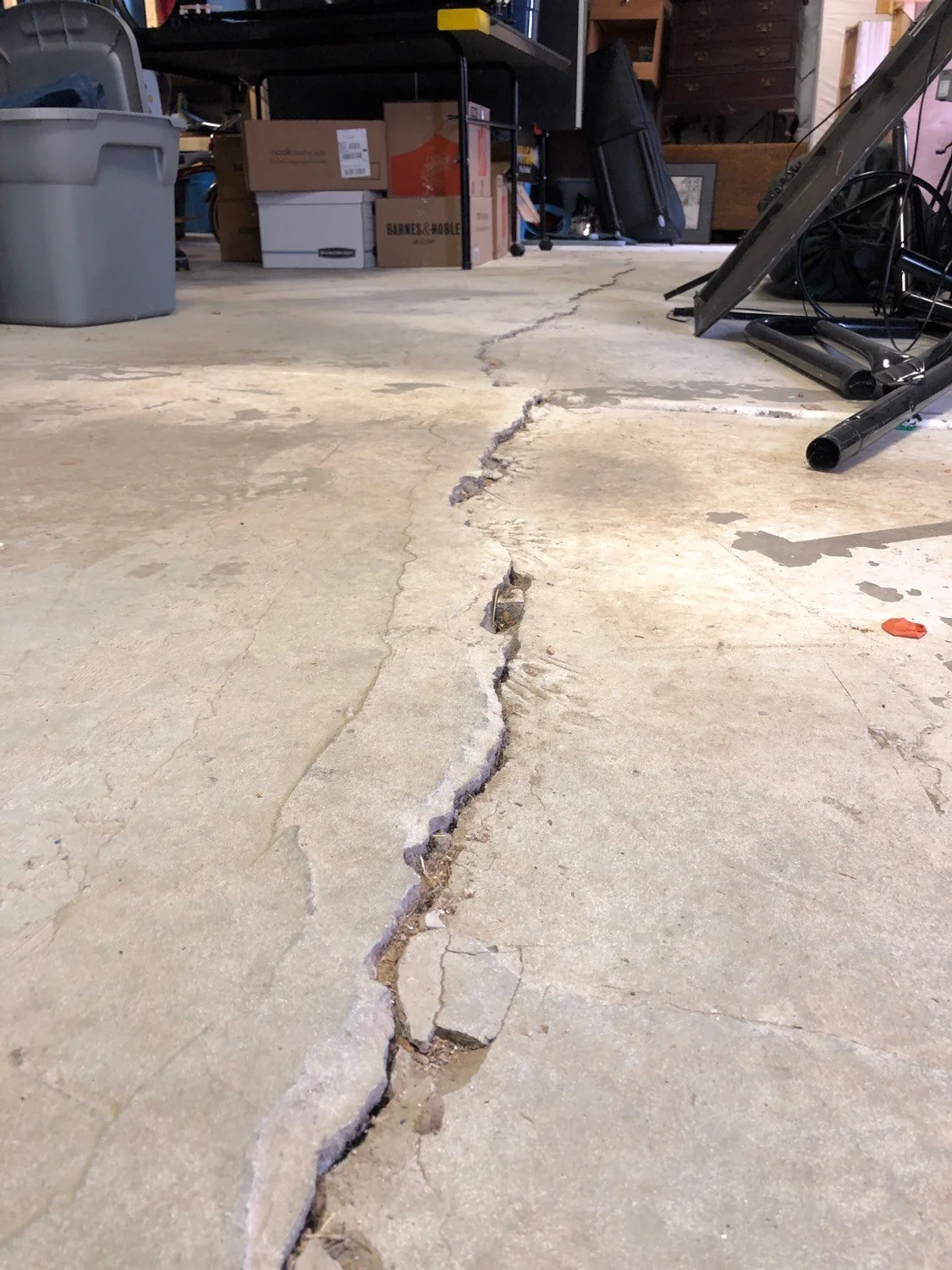
Concrete shrinkage is particularly common. As concrete cures, small cracks may form naturally as the material changes during the curing process. Basement slabs frequently develop cracks over time due to shrinkage or minor soil movement.
These conditions generally require monitoring rather than structural repair.
Crack patterns that deserve closer attention
Certain crack patterns can indicate excessive soil pressure, differential settlement, or structural movement.
Horizontal cracks in basement walls may suggest inward soil pressure. Bowing or leaning foundation walls, stair step cracking in masonry, and large diagonal cracks across foundation walls also deserve closer evaluation.
Other indicators of potential structural concern include cracks wider than roughly one quarter inch, floors that slope significantly, or doors and windows that suddenly become difficult to operate.
No single symptom provides the full picture. The significance depends on the location, pattern, and whether the affected component is part of the structure’s load path.
Basement specific movement issues
Because basements are so common in Denver homes, two movement conditions deserve particular attention.
Lateral soil pressure
When clay soils become saturated, they expand and exert pressure against basement walls. Over time, this pressure can contribute to horizontal cracking, inward bowing, or displacement of foundation walls.
Differential settlement
Uneven soil movement beneath the foundation can cause different portions of the structure to move at slightly different rates. This may appear as sloped floors, drywall cracking above openings, trim separation, or door misalignment.
Crawlspace specific concerns
Crawlspaces present their own set of performance challenges. Because these spaces are often exposed to soil air and outdoor humidity, moisture accumulation can occur if ventilation and drainage conditions are not well managed.
High humidity levels may contribute to mold growth, wood decay, and pest activity. Posts and beams may shift if support points move, and uneven floors may develop as structural supports respond to changing soil conditions.
Installing vapor barriers or encapsulating crawlspaces often helps reduce these risks by improving moisture control beneath the home.
Moisture management is the key factor
The single most important factor influencing expansive soil movement in Denver homes is inconsistent soil moisture.
Large swings between wet and dry soil conditions tend to produce the most movement. Maintaining relatively consistent moisture levels around the foundation helps limit expansion and contraction in the surrounding soils.
Common contributors to inconsistent moisture include downspouts discharging near the foundation, negative grading, poor surface drainage, missing downspout extensions, and heavy irrigation near the house.
A common drainage guideline is maintaining approximately six inches of slope away from the foundation within the first ten feet where site conditions allow.
Keeping water directed away from the home is one of the most effective ways to limit soil related foundation movement.
What repairs may be recommended
Foundation repair decisions should always be based on the cause of movement rather than the appearance of a crack alone.
In many cases, improving drainage and moisture control is the first step. This may involve correcting grading, extending downspouts, improving drainage pathways, or adjusting irrigation patterns.
When structural stabilization is needed, repair methods may include wall anchors, carbon fiber reinforcement, underpinning systems, slab leveling, or other engineered solutions.
The appropriate approach depends on how the structure is moving and which components are affected.
When a structural engineer may be appropriate
Further evaluation by a structural engineer may be recommended when there are signs of progressive movement, measurable wall displacement, major settlement, or structural distortion affecting load bearing components.
Engineering evaluation does not automatically mean a property is unsafe. In many cases, the purpose is simply to confirm the condition of the structure and determine whether stabilization measures are necessary.
Inspector Insight
During inspections throughout the Denver metro area, expansive soil related movement is one of the most frequently observed foundation conditions. Many homes show minor slab cracks, small finish cracks, or signs of gradual seasonal movement.
Inconsistent moisture around the structure is often a contributing factor. Downspouts terminating near the foundation, negative grading, and uneven irrigation patterns frequently appear where movement has occurred.
More significant concerns typically involve pattern recognition. Horizontal wall cracking, measurable wall bowing, differential floor movement, or displacement affecting load bearing elements deserve closer evaluation than isolated cosmetic cracks.
Understanding how Denver homes interact with expansive soils helps place these observations in proper context.
Practical implications for homeowners and buyers
For homeowners, maintaining proper drainage and moisture control around the home is the most effective way to reduce soil related movement. Monitoring how water drains during storms, extending downspouts away from the foundation, and avoiding excessive irrigation near the structure can significantly improve long term stability.
For buyers, it is helpful to recognize that many Denver homes show some history of cracking or movement. The presence of cracks alone does not necessarily indicate structural failure. What matters most is the pattern, severity, and location of the movement.
Careful inspection and informed interpretation help distinguish between common regional conditions and issues that may require further evaluation.
The bottom line
Expansive clay soils are a defining building condition across the Denver metro area. These soils swell when wet and shrink when dry, placing recurring stress on foundations, basement walls, crawlspaces, and slabs.
Because of this, some cracking and movement are common in Denver homes. Not all movement is structural, and not all cracks indicate serious problems. The significance depends on which building components are affected and whether those components are load bearing.
Understanding soil behavior, monitoring crack patterns, and maintaining proper drainage are the most effective ways to manage foundation performance in homes built on expansive soils.
Author
Andrew Sams is the founder of Alpine Building Performance, a Denver based residential and commercial inspection firm. He holds a B.S. in Building Science and has over 15 years of experience in building diagnostics, energy auditing, and property condition assessment.
Andrew is a Certified Master Inspector (CMI), Certified Commercial Property Inspector (CCPI), and Radon Measurement Specialist. He was named the Denver Metro Association of Realtors 2022 Industry Partner of the Year and teaches continuing education courses for real estate professionals throughout Colorado.