Federal Pacific and Zinsco Electrical Panels in Colorado Homes: What Inspectors Look For
Why Certain Electrical Panels Still Matter in Today’s Inspections
Electrical systems are designed around one critical assumption: when something goes wrong, protective devices will respond immediately. When that assumption is unreliable, the entire safety model of the system changes.
In Colorado homes built during the mid-century expansion period, two panel types still surface regularly during inspections—Federal Pacific Electric (FPE) and Zinsco. These panels were widely installed between the 1950s and late 1970s, and while many remain in service today, their long-term performance has raised consistent concerns within the inspection and electrical industries.
The issue is not simply age. It is the documented inconsistency in how these panels respond under fault conditions, particularly when breakers are expected to shut off power to prevent overheating and fire.
Why These Panels Are Common Across the Front Range
Large portions of the Denver metro area and surrounding Front Range communities were developed rapidly between approximately 1955 and 1980. Builders during this period relied on materials that were cost-effective, readily available, and easy to install at scale.
Federal Pacific and Zinsco panels met those criteria. As a result, they became standard components in thousands of homes constructed during that era.
Today, inspectors still encounter these panels in:
Mid-century neighborhoods in Denver and surrounding suburbs
Early suburban developments along the Front Range
Homes that have not undergone major electrical upgrades
Their continued presence is not unusual. What matters is how they perform relative to modern safety expectations.
What an Electrical Panel Is Supposed to Do
An electrical panel serves as the central distribution point for power throughout a building. More importantly, it acts as a safety control system.
Circuit breakers inside the panel are designed to:
Detect excessive electrical current
Interrupt power quickly during overloads or short circuits
Prevent wiring insulation from overheating
When functioning properly, breakers limit the risk of electrical fires by shutting down circuits before temperatures rise to dangerous levels.
If breakers fail to trip, the system no longer provides that protection. Electrical current continues flowing, and heat builds within the wiring system without interruption.
Federal Pacific Electric (FPE) Panels
How to Identify Them
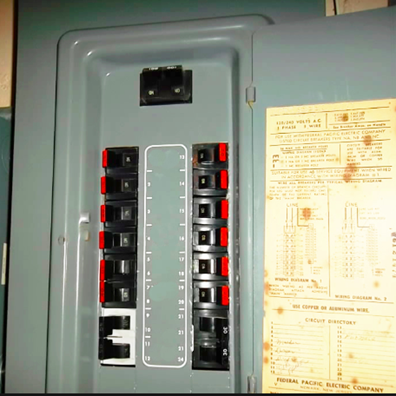
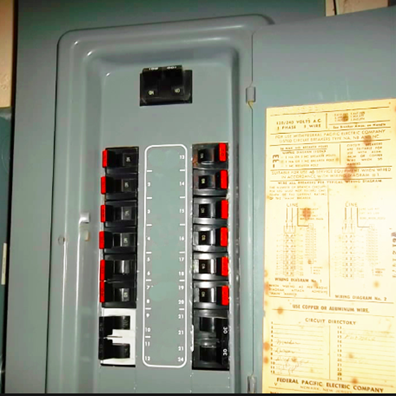
Federal Pacific panels are typically labeled:
Federal Pacific Electric
FPE
Breakers marked “Stab-Lok”
The Stab-Lok design refers to how breakers connect to the internal bus bar within the panel.
What Inspectors Are Concerned About
Independent testing and decades of field observation have shown that some FPE breakers may fail to trip under conditions where they should shut off power.
This creates several potential outcomes:
Wiring continues to carry excessive current
Heat builds beyond safe limits
Damage occurs before the system responds
Fire risk increases compared to modern equipment
It is important to understand that this is not a uniform failure. Many breakers appear to function normally under everyday conditions. The concern is the inconsistency—there is no reliable way to predict which breakers will fail during an actual fault.
That uncertainty is what drives most inspection recommendations.
Zinsco Electrical Panels
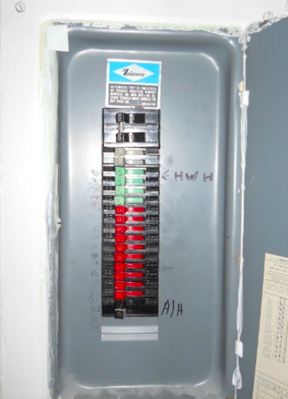
How to Identify Them
Zinsco panels are commonly labeled:
Zinsco
Sylvania-Zinsco
These panels use a different internal design than FPE systems but present their own set of concerns.
What Makes Them Problematic
The primary issue with Zinsco panels involves the connection between breakers and the internal bus bar.
Over time, breakers can lose proper contact with the bus bar while still appearing to be installed correctly. In some cases:
The breaker appears switched off, but the circuit remains energized
Connections overheat at the contact point
Breakers can fuse or melt into the panel
This creates a particularly misleading condition where a circuit is assumed to be de-energized but is still carrying current.
From a safety standpoint, that is a significant concern for both occupants and anyone performing electrical work.
Why Visual Inspection Has Limits
One of the most important aspects of evaluating these panels is understanding what cannot be seen during a standard home inspection.
Electrical inspections are non-invasive for safety reasons. Inspectors do not:
Disassemble breakers
Remove internal panel components
Perform destructive or load-based testing
Because the failure mechanisms in both FPE and Zinsco panels occur internally, a panel can appear functional during inspection while still having compromised safety performance.
For example:
Breakers may toggle on and off normally
Circuits may operate without issue during the inspection
No visible damage may be present
Despite this, the panel may still fail under actual overload or fault conditions.
For that reason, inspectors focus on identifying the panel type rather than attempting to verify individual breaker reliability.
Repair vs Replacement: Why Replacement Is Often Recommended
Replacement breakers are available for both Federal Pacific and Zinsco panels. On the surface, this may seem like a practical solution.
However, replacement does not necessarily address the underlying concerns:
Original panel design limitations remain
Compatibility and quality of replacement breakers can vary
Long-term performance is still uncertain
Because of these factors, many licensed electricians recommend full panel replacement rather than partial repair.
From a building performance standpoint, replacement offers:
Known reliability standards
Modern safety features
Improved compatibility with current electrical loads
In most cases, replacement is not about correcting a visible defect. It is about restoring confidence in how the system will respond under stress. Furthermore, both of these panels are now considered outdated and are often undersized for modern electrical loads.
Insurance and Real Estate Considerations
Beyond safety, these panels often affect real estate transactions and insurance underwriting.
Some insurance carriers:
Decline coverage for homes with FPE or Zinsco panels
Require panel replacement prior to issuing a policy
In real estate transactions, identifying one of these panels typically leads to:
Further evaluation by a licensed electrician
Negotiations between buyers and sellers
Consideration of replacement costs
Requirements vary widely depending on the insurer and the property, but the presence of these panels almost always triggers additional scrutiny.
When Further Electrical Evaluation Is Recommended
Further evaluation by a qualified electrician is commonly advised when:
The home contains an FPE or Zinsco panel
Breakers feel loose or unstable
The panel shows signs of overheating
Lights flicker when appliances cycle on
Circuits trip unpredictably
Even in the absence of symptoms, identification alone is often enough to justify a deeper evaluation.
Inspector Insight
In the field, these panels are rarely identified because something has already failed. Most are discovered during routine inspections of otherwise functional homes.
What stands out is how often clients assume that “working” means “safe.” If lights turn on and breakers have not tripped, the system is assumed to be performing as intended.
That assumption is exactly where the risk lies.
With both Federal Pacific and Zinsco panels, the concern is not day-to-day operation. It is how the system behaves during a fault condition—the moment when safety mechanisms matter most.
Because that behavior cannot be confirmed visually, the conversation shifts from observable defects to reliability. That is a different kind of evaluation, and it is why these panels are consistently flagged.
Practical Implications for Buyers and Homeowners
For buyers, the presence of one of these panels should be viewed as a known condition rather than an immediate defect. It does not mean the system is currently failing, but it does introduce uncertainty that should be addressed.
Typical next steps include:
Obtaining an evaluation from a licensed electrician
Budgeting for potential panel replacement
Understanding how the panel may affect insurance
For current homeowners, replacement is often a proactive decision. It reduces uncertainty and aligns the electrical system with modern safety expectations.
For agents, these panels can influence transaction timelines and negotiations. Early identification helps set expectations and avoid last-minute complications.
Key Takeaways
Federal Pacific and Zinsco panels were widely installed in mid-century homes across Colorado and remain common today. The primary concern is not visible damage, but inconsistent breaker performance under fault conditions.
Because that behavior cannot be reliably tested during a standard inspection, identification alone often leads to further evaluation. In many cases, full panel replacement is recommended to restore confidence in the system’s ability to respond safely.
Author
Andrew Sams is the founder of Alpine Building Performance, a Denver based residential and commercial inspection firm. He holds a B.S. in Building Science and has over 15 years of experience in building diagnostics, energy auditing, and property condition assessment.
Andrew is a Certified Master Inspector (CMI), Certified Commercial Property Inspector (CCPI), and Radon Measurement Specialist. He was named the Denver Metro Association of Realtors 2022 Industry Partner of the Year and teaches continuing education courses for real estate professionals throughout Colorado.