Furnace Venting Problems in Older Denver Homes
Background
Furnace venting is one of the most important safety-related systems in a home, yet it is often misunderstood during real estate transactions.
A furnace can turn on, produce heat, and appear to operate normally while still having venting concerns. The issue is not simply whether the home gets warm. The more important question is whether combustion gases are leaving the home safely.
In older Denver homes, furnace venting problems are especially common because heating systems have often been changed over time. A home may have originally used a gravity furnace, then a natural-draft furnace, then a mid-efficiency furnace, and eventually a high-efficiency system. During those updates, the venting system, chimney, combustion air, and water heater connections may not always have been updated correctly.
This is similar to many older-house inspection issues: the concern is often not the original system alone, but how that system has been modified over decades. That same pattern appears in older electrical systems, plumbing systems, and legacy components such as knob-and-tube wiring or older sewer lines.
Furnace venting problems should be taken seriously because improper venting can allow carbon monoxide or other combustion byproducts to enter the home. Not every venting defect means there is an immediate emergency, but these conditions deserve careful evaluation.
Key Takeaways
Furnace venting is designed to remove combustion gases safely from the home.
Older Denver homes often have venting concerns because furnaces, water heaters, chimneys, and duct systems have been modified over time.
A furnace can appear to operate normally while still having venting or combustion air issues.
Common problems include improper vent connectors, deteriorated chimney liners, orphaned water heaters, backdrafting, poor combustion air, and incorrect high-efficiency furnace venting.
Carbon monoxide alarms are important, but they are not a substitute for proper venting and equipment evaluation.
Visible venting concerns during a home inspection commonly lead to further evaluation by a qualified HVAC contractor.
Why furnace venting matters
Fuel-burning furnaces produce heat by burning natural gas or another fuel. That combustion process creates byproducts that must be carried safely outdoors.
These byproducts can include:
Carbon monoxide
Carbon dioxide
Water vapor
Nitrogen oxides
Other combustion gases
When the venting system works properly, these gases are directed out of the home through a flue, vent pipe, or sidewall exhaust system.
When venting does not work properly, combustion gases can spill back into the living space, mechanical room, basement, crawlspace, or attic.
Carbon monoxide is the primary safety concern because it is colorless, odorless, and potentially dangerous. Occupants cannot rely on smell or appearance to detect it.
This is why furnace venting is evaluated as a safety issue, not simply an equipment-performance issue.
How older furnaces typically vent
Many older furnaces use natural-draft venting.
Natural-draft systems rely on hot combustion gases rising through a metal vent connector and chimney or flue. As the gases warm the flue, they become buoyant and rise upward, carrying combustion byproducts out of the home.
This type of system depends on several conditions working together:
Hot enough exhaust gases
Proper vent pipe slope
Correct flue size
Adequate chimney draft
Sufficient combustion air
No blockage or restriction
Proper connection between appliances and the chimney
If one part of this system is wrong, draft can become weak or unreliable.
Older Denver homes often have masonry chimneys that originally served different equipment than what is installed today. When heating equipment is replaced, the existing chimney may not always be appropriate for the new appliance.
Why older Denver homes are more vulnerable to venting problems
Denver has a large stock of older homes, including properties built before modern heating equipment, modern combustion air standards, and current venting practices.
Many older homes have gone through multiple heating system updates. Each update may have changed the way the home handles combustion gases.
Common older-home conditions include:
Original masonry chimneys
Abandoned chimney flues
Partially updated furnace systems
Water heaters still connected to old chimneys
Finished basements that enclose mechanical rooms
Added exhaust fans
Tighter windows and air sealing upgrades
Remodels that reduce combustion air
Mixed old and new equipment
These changes can affect how the venting system performs.
A home that drafted adequately decades ago may no longer behave the same way after new windows, added insulation, remodeled basements, kitchen exhaust fans, bath fans, or new HVAC equipment are installed.
This is one reason furnace venting should be evaluated in context. The equipment, chimney, mechanical room, and building envelope all interact.
Natural draft, induced draft, and high-efficiency furnaces
Not all furnaces vent the same way.
Understanding the furnace type helps explain what venting issues may be present.
Natural-draft furnaces
Natural-draft furnaces rely on warm exhaust gases rising naturally through the flue.
These systems are more sensitive to chimney conditions, vent sizing, combustion air, and pressure differences in the home.
Common concerns include backdrafting, poor vent slope, deteriorated vent connectors, and inadequate combustion air.
Induced-draft furnaces
Many mid-efficiency furnaces use an inducer fan to help move combustion gases into the vent system.
These furnaces are generally more controlled than older natural-draft equipment, but they still often vent through metal flue pipes and may still use a chimney or B-vent system.
Common concerns include improper vent materials, poor vent connections, corrosion, and shared venting issues with water heaters.
High-efficiency condensing furnaces
High-efficiency furnaces remove more heat from the combustion process and produce cooler exhaust.
Because the exhaust is cooler and contains condensate, these systems usually vent through PVC, CPVC, polypropylene, or other approved plastic venting materials depending on the manufacturer.
They also require condensate drainage.
Common concerns include improper pipe slope, poor termination location, unsupported piping, inadequate clearance from openings, condensate freezing, and intake/exhaust recirculation.
High-efficiency systems solve some old chimney-related issues but introduce their own installation concerns.
Backdrafting
Backdrafting occurs when combustion gases that should leave through the vent instead spill back into the home.
This is one of the more important furnace venting concerns.
Backdrafting may occur because of:
Blocked or restricted flues
Cold chimney conditions
Improper vent sizing
Negative pressure in the home
Inadequate combustion air
Poor vent connector slope
Competing exhaust appliances
Deteriorated chimney liners
Backdrafting can be intermittent. A furnace or water heater may draft properly under one set of conditions and spill combustion gases under another.
For example, draft may change when a kitchen exhaust fan, clothes dryer, bath fan, or fireplace is operating. Tightened homes may also have less available makeup air than they once did.
This is why a single observation does not always tell the full story.
Orphaned water heaters
An orphaned water heater is a common condition in older homes after a furnace replacement.
This usually happens when an older furnace and water heater previously shared a chimney. If the furnace is replaced with a high-efficiency model that vents through plastic pipe to the exterior, the water heater may be left alone to vent into the original chimney.
The problem is that the chimney may now be too large for the remaining water heater.
Without the furnace also contributing heat to the chimney, the water heater may not produce enough warm exhaust to maintain proper draft. This can lead to condensation, weak draft, chimney deterioration, or backdrafting.
This condition is especially common in older homes where heating equipment has been upgraded in stages rather than as a coordinated system.
The water heater may still produce hot water, but the venting arrangement may no longer be appropriate.
Masonry chimney concerns
Many older Denver homes have masonry chimneys. These chimneys may have originally served coal appliances, gravity furnaces, boilers, or older natural-draft equipment.
When modern appliances are connected to older masonry chimneys, several concerns can develop.
Common issues include:
Missing or deteriorated liners
Oversized flues
Cracked clay tile liners
Condensation inside the chimney
Spalling masonry
Poor draft
Multiple appliances venting improperly
Abandoned flue openings
Lack of proper cleanout access
Combustion gases contain moisture. If those gases cool too quickly inside a chimney, condensation can form. Over time, that moisture can deteriorate the chimney interior.
This is especially important when newer, more efficient appliances produce cooler exhaust than older equipment.
A chimney that appears intact from the exterior may still have internal liner defects that affect safe venting.
Vent connector problems
The vent connector is the metal pipe that carries combustion gases from the furnace or water heater to the chimney or vent system.
Common vent connector defects include:
Improper slope
Loose connections
Missing screws
Corrosion
Holes or gaps
Incorrect pipe material
Single-wall pipe too close to combustibles
Long horizontal runs
Too many elbows
Disconnected sections
Unsupported piping
Vent connectors should generally rise upward toward the chimney or vent. If the connector slopes downward, has excessive horizontal distance, or contains poor connections, draft can be weakened.
Corrosion is also important. Rust on a vent connector may indicate condensation, poor draft, or improper venting.
Small vent pipe defects can have meaningful safety implications because they involve combustion gases.
Combustion air problems
Fuel-burning appliances need air for combustion.
In older homes, combustion air often came from natural leakage through walls, windows, doors, and basements. As homes are tightened through window replacement, insulation, air sealing, and basement finishing, that air supply can be reduced.
Combustion air problems may occur when furnaces or water heaters are located in:
Small closets
Finished mechanical rooms
Enclosed basements
Utility rooms with tight doors
Crawlspaces with limited ventilation
Rooms shared with exhaust appliances
If appliances cannot get enough air, combustion may become incomplete or venting may become unstable.
This can increase carbon monoxide risk and make backdrafting more likely.
A common issue in finished basements is that a furnace or water heater originally located in an open basement becomes enclosed in a small mechanical room during remodeling. If combustion air openings are not added or sized correctly, the appliance environment changes significantly.
Negative pressure in the home
Pressure differences inside a home can affect furnace venting.
Exhaust devices remove air from the house. If replacement air cannot enter easily, the home can become negatively pressurized. That negative pressure can pull combustion gases back down a flue instead of allowing them to rise out of the home.
Common contributors include:
Kitchen range hoods
Bathroom exhaust fans
Clothes dryers
Whole-house fans
Fireplaces
Leaky return ducts
Tight windows and doors
Air sealing upgrades
This is one reason furnace venting is a building science issue, not just an HVAC issue.
The furnace, water heater, duct system, exhaust fans, chimney, and building envelope all influence one another.
High-efficiency furnace venting problems
High-efficiency condensing furnaces are common replacements in older Denver homes.
These systems often vent through plastic pipes that terminate at the exterior wall or roof. They may also pull combustion air from outdoors through a separate intake pipe.
Common high-efficiency venting concerns include:
Improper pipe slope
Unsupported PVC venting
Incorrect pipe material
Exhaust too close to windows or doors
Intake and exhaust too close together
Exhaust termination near grade or snow level
Condensate freezing at the termination
Poorly sealed wall penetrations
Recirculation of exhaust into the intake
Missing manufacturer-required clearances
Because high-efficiency furnace exhaust contains moisture, the venting system must be installed to manage condensate properly.
In Colorado, sidewall terminations also need to be positioned so snow, ice, landscaping, or stored items do not block the intake or exhaust.
A high-efficiency furnace can be a good upgrade, but its performance depends heavily on installation quality.
Condensate drainage concerns
Condensing furnaces produce water as part of normal operation.
That condensate must be collected and drained properly. If condensate does not drain correctly, the furnace may shut down, leak, corrode components, or create moisture damage around the equipment.
Common condensate issues include:
Clogged condensate trap
Missing neutralizer where needed
Discharge into inappropriate locations
Poor pipe slope
Leaking condensate tubing
Frozen condensate lines
Condensate pump failure
Water staining near the furnace
In older homes, condensate drainage can be challenging because floor drains may be absent, poorly located, or not functional.
This is especially common when a high-efficiency furnace is retrofitted into a basement or mechanical room that was originally designed for older equipment.
Water heaters and shared venting
Furnaces and water heaters often share venting systems, especially in older homes.
When both appliances are connected to the same chimney or B-vent, the system must be configured so both can draft properly.
Common shared venting concerns include:
Incorrect connector arrangement
Undersized or oversized venting
Poor slope
Water heater entering the vent above the furnace incorrectly
Corroded connectors
Backdrafting at the water heater draft hood
Furnace replacement that changes draft conditions
Water heaters are often more vulnerable to draft problems because they produce less heat than furnaces and may not warm a large chimney effectively on their own.
This is why water heater venting should be evaluated whenever furnace equipment has been changed.
Signs of possible venting problems
Some venting concerns are visible during a home inspection. Others require specialized testing or only appear under certain operating conditions.
Possible visible clues include:
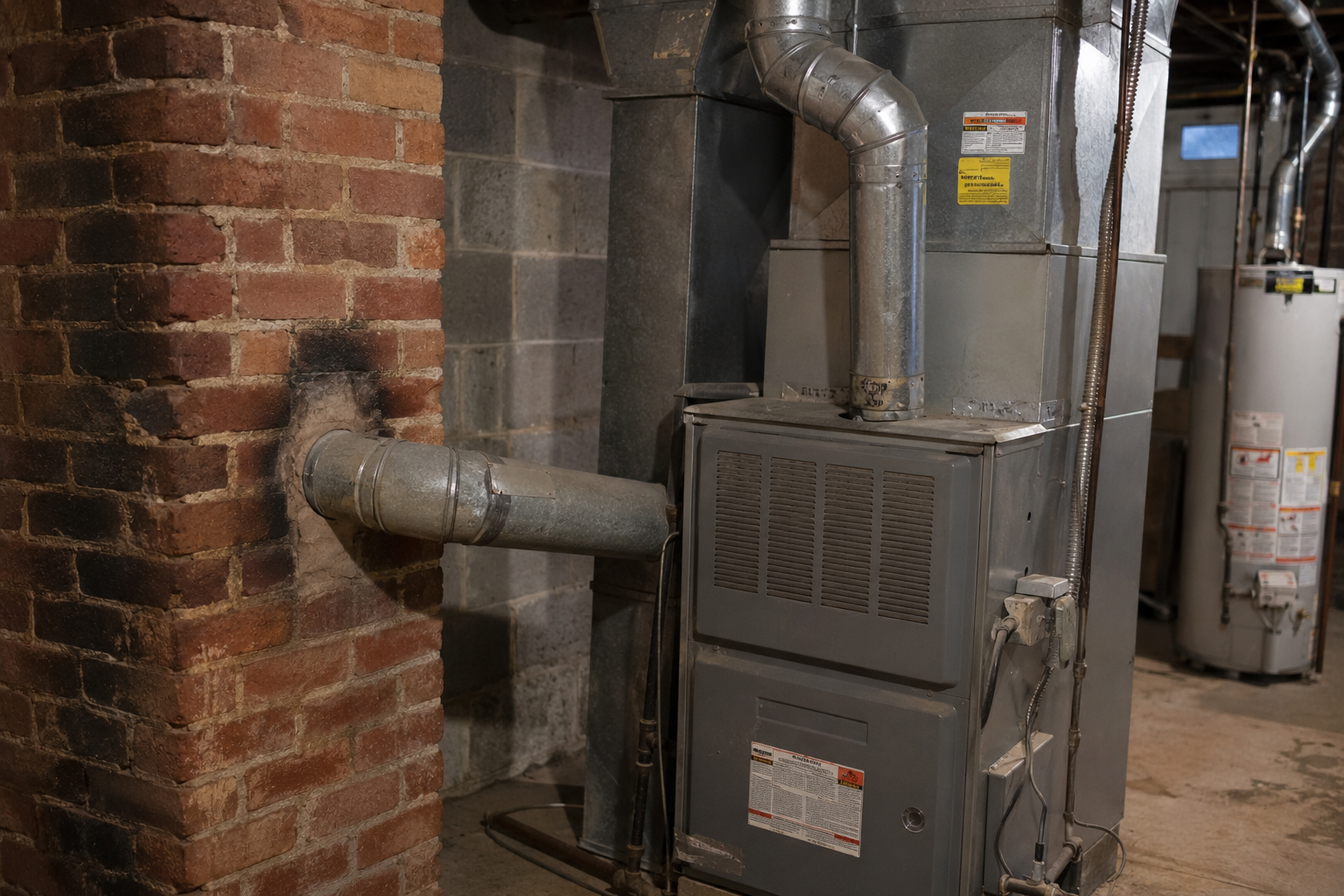
Rusted vent connectors
Melted plastic near draft hoods
Sooting or staining around appliances
Corrosion on top of a water heater
Moisture staining near the chimney
Damaged or missing chimney liner components
Loose or disconnected vent pipes
Burn marks near the furnace or water heater
Condensation inside vent piping
Unusual odors near equipment
Carbon monoxide alarm history
Mechanical room doors without combustion air openings
These signs do not all mean the same thing, but they indicate conditions that deserve closer evaluation.
Carbon monoxide alarms are not a substitute for proper venting
Carbon monoxide alarms are essential life safety devices, but they should not be viewed as the primary method of managing combustion safety.
A carbon monoxide alarm is a warning device. It does not correct poor draft, improper venting, equipment defects, or inadequate combustion air.
A home should have properly installed and maintained carbon monoxide alarms, especially near sleeping areas and where fuel-burning appliances are present.
However, the goal is to prevent combustion gases from entering the home in the first place.
Proper venting, equipment maintenance, combustion air, and professional evaluation are still necessary.
What inspectors look for
During a home inspection, furnace venting is evaluated visually and operationally where conditions allow.
Inspectors commonly look for:
Furnace type
Vent material
Vent slope
Vent connector condition
Signs of corrosion
Loose or disconnected venting
Draft hood concerns
Shared venting configuration
Chimney connection
Combustion air availability
Exterior vent termination location
Condensate drainage for high-efficiency systems
Evidence of backdrafting or spillage
Carbon monoxide alarm presence
A standard home inspection does not fully certify the venting system. Inspectors do not typically perform full combustion analysis, draft testing under all operating conditions, chimney camera inspections, or HVAC design calculations.
When visible concerns are present, further evaluation by a qualified HVAC contractor is commonly recommended.
When further evaluation may be appropriate
Further evaluation may be recommended when:
Backdrafting is observed or suspected
Vent connectors are corroded, loose, or improperly sloped
A water heater appears orphaned after furnace replacement
The chimney liner appears damaged or absent
Combustion air appears inadequate
A high-efficiency furnace has improper vent termination
Condensate drainage is leaking or poorly configured
Sooting, scorch marks, or unusual staining are present
Carbon monoxide concerns have been reported
Equipment is old or poorly maintained
Furnace replacement appears incomplete or improperly adapted to the existing chimney
Further evaluation does not always mean replacement is needed. It helps determine whether the venting system is safe, appropriate, and correctly matched to the equipment.
Why maintenance history matters
Furnace venting problems often become more likely when systems are not serviced regularly.
Annual service can help identify:
Dirty burners
Poor combustion
Weak draft
Vent connector corrosion
Blocked condensate drains
Inducer motor issues
Heat exchanger concerns
Improper flame characteristics
Early signs of equipment failure
A home inspection provides a snapshot of visible conditions at one point in time. HVAC service provides a more detailed evaluation of equipment performance.
For older homes, maintenance records can be useful because they show whether the system has been regularly evaluated rather than simply operated until failure.
Inspector Insight
During inspections in older Denver homes, furnace venting concerns often appear after partial upgrades.
One of the most common patterns is a newer high-efficiency furnace installed in a home where the older water heater still vents into the original masonry chimney. The furnace may have been improved, but the water heater’s venting conditions may have become less reliable because it is now the only appliance warming the chimney.
Another common pattern is basement finishing around existing mechanical equipment. A furnace and water heater that once had plenty of surrounding air may now be enclosed in a small room with limited combustion air. The equipment did not change, but the room around it did.
Venting issues also tend to be misunderstood because the furnace may still heat the home. From an inspection standpoint, the question is not only whether heat is produced. The question is whether combustion gases are being managed safely under real operating conditions.
That distinction is important for buyers, homeowners, and agents.
Practical implications for homeowners and buyers
For homeowners, furnace venting should be part of regular HVAC maintenance. Replacing equipment, finishing a basement, adding exhaust fans, or tightening the home can all affect combustion safety. If the home has natural-draft equipment, an older chimney, or a shared venting arrangement, periodic evaluation is especially important.
For buyers, furnace venting findings should be taken seriously but interpreted in context. A corroded vent connector may be a relatively straightforward repair. An orphaned water heater, backdrafting condition, or deteriorated chimney liner may require more significant correction.
For agents, furnace venting issues can create confusion because they are not always visible to clients during showings. The system may appear normal until the inspection identifies a safety concern. Clear explanation helps keep the issue focused on proper evaluation rather than fear.
The bottom line
Furnace venting problems are common in older Denver homes because heating systems, water heaters, chimneys, and mechanical rooms have often changed over time.
The concern is not simply whether the furnace works. The more important issue is whether combustion gases are leaving the home safely.
Older natural-draft systems, shared chimneys, orphaned water heaters, inadequate combustion air, and improperly installed high-efficiency furnace vents can all create safety concerns.
A home inspection can identify visible venting issues and conditions that deserve further evaluation. When concerns are found, a qualified HVAC contractor can determine whether repair, maintenance, chimney work, or equipment replacement is appropriate.
Author
Andrew Sams is the founder of Alpine Building Performance, a Denver based residential and commercial inspection firm. He holds a B.S. in Building Science and has over 15 years of experience in building diagnostics, energy auditing, and property condition assessment.
Andrew is a Certified Master Inspector (CMI), Certified Commercial Property Inspector (CCPI), and Radon Measurement Specialist. He was named the Denver Metro Association of Realtors 2022 Industry Partner of the Year and teaches continuing education courses for real estate professionals throughout Colorado.