
Galvanized Plumbing in Older Denver Homes
Galvanized Plumbing in Older Denver Homes: What Buyers Should Understand
Galvanized plumbing is one of the most common legacy plumbing materials found in older Denver homes. It may still deliver water, fixtures may operate, and no active leaks may be visible during an inspection. But the presence of galvanized steel piping can still raise important questions about water flow, corrosion, remaining service life, future replacement, and hidden deterioration.
Galvanized steel piping was widely used in residential water distribution systems before copper and modern plastic piping became common. In many Denver homes built before the 1960s, galvanized supply piping may still be present in some form. In other homes, the system may have been partially updated over time, leaving a mix of galvanized steel, copper, PEX, and newer fixture connections.
The concern with galvanized plumbing is not simply age. The concern is how the material deteriorates from the inside.
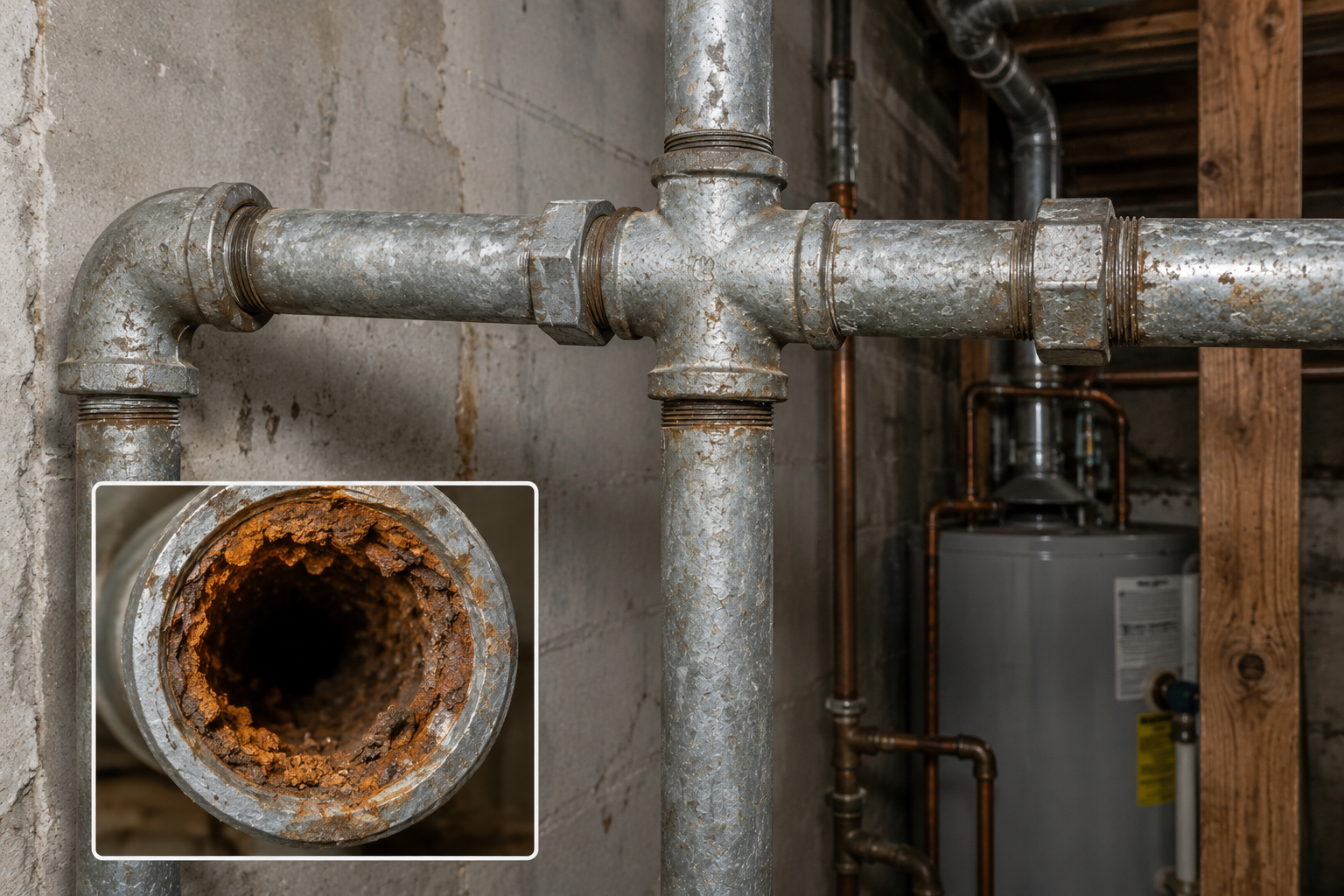
Over time, galvanized steel pipes corrode internally. Rust and mineral buildup gradually reduce the inside diameter of the pipe. From the outside, the pipe may look intact. Inside, however, the opening may be significantly restricted.
This is why galvanized plumbing can be difficult to evaluate based on appearance alone. A pipe may not be leaking today, but it may still be near the end of its useful life.
Key Takeaways
Galvanized steel water piping is common in older Denver homes, especially homes built before the 1960s.
The main concern is internal corrosion, which can restrict water flow and eventually lead to leakage.
Visible pipe condition does not always reveal the condition inside the pipe.
Low water pressure, rusty water, old valves, and partial plumbing updates are common clues.
Many older homes have mixed plumbing systems where some galvanized piping remains concealed behind walls or ceilings.
Replacement planning is often appropriate when active galvanized water distribution piping is present.
What galvanized plumbing is
Galvanized plumbing is steel piping coated with a protective layer of zinc. The zinc coating was intended to slow corrosion and extend the pipe’s service life.
For many decades, galvanized steel was a standard water supply material in residential construction. It was strong, durable, and widely available.
In older homes, galvanized piping may serve:
Main water distribution lines
Branch lines to bathrooms
Kitchen supply piping
Laundry connections
Hose bibbs
Basement plumbing runs
Older fixture connections
Galvanized piping is usually threaded together at fittings. The pipe is rigid, heavy, and often silver-gray when newer, though older piping may appear dull, dark, rusted, painted, or partially concealed.
Why galvanized piping became common in Denver homes
Denver has a large stock of older homes built before copper and PEX became standard plumbing materials. Neighborhoods with early and mid-century housing are more likely to contain galvanized plumbing, especially if the home has not undergone a full repipe.
Galvanized piping may be found in homes in or near older Denver neighborhoods such as:
Capitol Hill
Baker
Five Points
Congress Park
Washington Park
Park Hill
City Park
Whittier
Highlands and West Highlands
Older areas of Englewood, Lakewood, and Wheat Ridge
Not every older home contains galvanized plumbing, and many have been partially or fully updated. But the age of the home provides useful context during inspection.
In many cases, galvanized piping remains in concealed areas even when visible fixture connections have been modernized.
How galvanized piping deteriorates
Galvanized pipe deterioration usually happens gradually.
The zinc coating inside the pipe wears away over time. Once the steel is exposed to water and oxygen, corrosion begins. Rust and mineral deposits build up along the inside walls of the pipe.
As that buildup increases, the interior opening becomes smaller.
This can lead to:
Reduced water pressure
Restricted flow
Uneven flow between fixtures
Rust-colored water
Clogged aerators
Leaking threaded joints
Corrosion at fittings
Increased stress on valves and fixtures
One of the most important points is that the pipe may deteriorate internally long before the exterior condition looks severe.
A galvanized pipe can look solid from the outside while being heavily restricted inside.
Pressure versus flow: why buyers get confused
Buyers often describe galvanized plumbing problems as “low water pressure,” but the issue is often reduced flow.
Pressure and flow are related, but they are not the same thing.
Water pressure refers to the force in the plumbing system. Flow refers to how much water can move through the pipe.
A galvanized pipe with heavy internal buildup may still have normal static pressure when no fixtures are running. But when multiple fixtures are used at the same time, the restricted pipe cannot deliver enough water volume.
This is why a home may seem acceptable when one sink is turned on but perform poorly when someone showers while another fixture is running.
Common flow-related symptoms include:
Weak shower performance
Noticeable drop when multiple fixtures run
Slow tub filling
Poor hot water flow
Uneven flow between bathrooms
Reduced flow at second-floor fixtures
Washing machine fill delays
During a home inspection, fixture operation can provide clues, but it does not fully measure the condition of concealed piping.
Rust-colored water
Rust-colored water is one of the most recognizable signs associated with aging galvanized piping.
This discoloration may appear:
When water is first turned on after sitting
At fixtures used less frequently
In hot water lines
After plumbing work disturbs sediment
During periods of changing water pressure
Rust-colored water can have several causes, including water heater sediment, municipal water disturbances, or old piping. But in a home with galvanized plumbing, internal corrosion is an important possibility.
Even if the water clears after running for a short time, the discoloration may indicate deterioration inside the piping system.
Galvanized piping and water heaters
Galvanized piping can affect hot water performance.
Hot water often accelerates corrosion compared with cold water. As a result, galvanized hot water lines may show more restriction or deterioration than cold water lines.
Common hot water symptoms include:
Reduced hot water flow
Delayed hot water delivery
Rust-colored hot water
Sediment at fixtures
Corroded nipples or connections at the water heater
Leaking or difficult-to-operate valves
Older water heaters connected to galvanized piping may also have corrosion at the supply connections. When replacing a water heater, plumbers sometimes discover that nearby galvanized piping is brittle, restricted, or difficult to modify.
This is one reason plumbing upgrades can expand once work begins. A simple fixture or water heater replacement may reveal broader piping concerns.
Threaded joints and leakage
Galvanized piping uses threaded fittings. Over time, corrosion often develops at these joints.
Common concerns include:
Rust at fittings
Small leaks
Mineral deposits
Previous patch repairs
Pipe movement near joints
Corrosion where pipe enters walls
Deterioration at shutoff valves
Threaded joints can become fragile with age. Attempting to repair one section may disturb adjacent sections, creating additional leaks.
For this reason, older galvanized systems are often less practical to repair one fitting at a time. Replacement of larger sections may be more appropriate when deterioration is widespread.
Partial repipes and mixed plumbing systems
Many older Denver homes have been partially repiped.
A home may have copper or PEX visible near the water heater, under sinks, or in remodeled bathrooms, while galvanized piping remains in walls, ceilings, or older portions of the basement.
This creates a mixed plumbing system.
Mixed systems are common because plumbing is often updated in stages:
A kitchen remodel replaces piping in one area.
A bathroom remodel updates supply lines to that room.
A leaking pipe is repaired with copper or PEX.
A water heater replacement includes short sections of new pipe.
Basement plumbing is updated while upper-floor piping remains original.
Partial updates can improve specific areas, but they do not necessarily mean the entire plumbing system has been modernized.
During inspections, visible newer piping should not be assumed to represent the whole house.
Dissimilar metals and dielectric connections
Galvanized steel is sometimes connected directly to copper piping during partial updates.
When dissimilar metals are connected improperly, corrosion can accelerate at the connection point. This is why proper transition fittings are important.
Common concerns include:
Copper connected directly to galvanized steel
Corrosion at transition fittings
Improper or missing dielectric unions
Leaks at mixed-material joints
Poorly supported transition points
Not every mixed-material connection is automatically defective, but transitions should be evaluated carefully. Poor transitions often indicate lower-quality repair work or piecemeal updates.
Galvanized drain piping versus galvanized supply piping
Galvanized steel may be used in water supply piping, drain piping, or both.
This article focuses mainly on galvanized water supply piping, but older galvanized drain piping can also create problems.
Galvanized drain piping may develop:
Internal rust buildup
Slow drainage
Leaks at joints
Corrosion at horizontal runs
Sewer odors
Poor repairs
Drainage defects may show up differently than supply piping concerns. Instead of reduced water flow, the issue may be slow drainage, leakage, or corrosion.
Older homes may also contain cast iron drains, clay sewer piping, or other legacy materials. That broader plumbing context matters during inspection, especially in Denver homes with older underground sewer infrastructure.
Your existing sewer line article covers those underground concerns separately, including clay tile, cast iron, Orangeburg, root intrusion, pipe offsets, and sewer scope limitations.
Galvanized piping and remodel work
Remodeled homes can be especially misleading.
A bathroom may have new tile, new fixtures, modern faucets, and fresh finishes while older galvanized piping remains inside the wall.
This can create several issues:
Reduced flow to new fixtures
Leaks behind new finishes
Difficult future repairs
Hidden corrosion
Costly access problems
Confusion about what was actually updated
A cosmetic remodel does not necessarily mean the plumbing system was replaced.
During inspections, it is important to distinguish between updated fixtures and updated piping. A new faucet connected to an old galvanized supply line is still dependent on the old piping behind it.
What inspectors look for
During a home inspection, galvanized plumbing is evaluated where visible and accessible.
Inspectors commonly look for:
Pipe material
Visible corrosion
Leakage
Rust staining
Mineral deposits
Pipe support
Mixed material transitions
Water pressure and flow at fixtures
Fixture operation
Evidence of previous repairs
Visible piping in basements, crawlspaces, and mechanical rooms
Water heater connections
Shutoff valve condition
The goal is to identify visible concerns and provide context for the buyer. However, much of the plumbing system may be concealed, especially in finished homes.
A home inspection cannot determine the internal diameter of every pipe or predict exactly when a pipe may leak.
Common signs that galvanized piping may be affecting performance
Several clues may suggest that galvanized piping is restricting flow or nearing the end of its useful life.
These include:
Low flow at multiple fixtures
Rust-colored water
Inconsistent hot and cold water flow
Slow tub filling
Poor shower performance
Corroded visible piping
Old shutoff valves that do not operate
Frequent faucet aerator clogging
Water staining near pipe penetrations
Patch repairs on older piping
Mixed materials with poor transitions
No single symptom tells the whole story. But when several are present together, further plumbing evaluation is usually appropriate.
Insurance and transaction considerations
Galvanized plumbing does not usually create the same universal concern as polybutylene, but it can still affect buyer expectations, repair negotiations, and replacement planning.
Some insurance carriers may ask about plumbing materials, especially in older homes. Requirements vary.
For buyers, the more immediate concern is often cost and timing. If galvanized piping is still active, they may need to budget for future replacement even if no leak is visible during the inspection.
For sellers, partial plumbing updates can be helpful to document. If a full repipe was completed, invoices, permits, and contractor records may help clarify the extent of replacement.
Replacement versus repair
The decision to repair or replace galvanized plumbing depends on the extent of the material, its condition, accessibility, and performance.
Small isolated repairs may be reasonable when galvanized piping is limited and otherwise stable. However, if the system is widespread, corroded, restricted, or repeatedly leaking, full or substantial replacement is often more practical.
Replacement materials commonly include:
Copper
PEX
Other approved modern water distribution piping
Repiping may involve opening walls or ceilings, rerouting lines, replacing shutoff valves, reconnecting fixtures, and repairing finishes.
The cost depends on access, home size, number of fixtures, finish conditions, and whether the work is done as part of a larger remodel.
Why replacement can be difficult in older homes
Replacing galvanized plumbing in older Denver homes can be more complicated than replacing piping in newer construction.
Older homes may have:
Plaster walls
Finished basements
Limited access cavities
Multiple remodel layers
Older tile bathrooms
Tight framing spaces
Mixed plumbing materials
Unknown concealed conditions
Because of these factors, replacement cost is not just about the pipe material. Access and finish restoration can be a major part of the project.
This is why buyers should obtain estimates when galvanized plumbing is a significant concern.
What buyers should ask
When galvanized plumbing is identified, buyers should gather more information before closing.
Helpful questions include:
How much galvanized piping is visible?
Does it appear to serve the full home or only limited areas?
Are there signs of reduced flow?
Is there rust-colored water?
Have any sections been replaced?
Are there records of a full or partial repipe?
Are bathrooms or kitchens recently remodeled?
Is galvanized piping still present behind new finishes?
Are there active leaks or corrosion?
What would replacement likely involve?
These questions help buyers understand whether the issue is minor, localized, or part of a larger plumbing replacement plan.
What a standard home inspection can and cannot determine
A standard home inspection can identify visible galvanized piping and document related concerns such as corrosion, leakage, poor flow, or mixed-material repairs.
However, a home inspection cannot:
See inside walls or ceilings
Measure internal pipe restriction throughout the system
Confirm the condition of concealed piping
Determine exact remaining service life
Guarantee that all galvanized piping has been removed
Predict when a leak may occur
Provide a full repipe cost estimate
This limitation is important. The inspection can identify the material and explain why it matters, but it cannot fully map the concealed plumbing system.
When further evaluation may be appropriate
Further evaluation by a licensed plumber may be recommended when:
Galvanized piping is widespread
Water flow is poor
Rust-colored water is observed
Visible corrosion is present
Prior repairs are noted
Mixed-material transitions appear improper
A remodel may have left old piping concealed
The buyer wants replacement cost information
Leakage or staining is present
Further evaluation does not always mean immediate replacement is required. It helps clarify the extent of the system, the likely cost of upgrades, and whether the piping is affecting performance.
Inspector Insight
During inspections in older Denver homes, galvanized plumbing often tells a story of partial updates.
It is common to see copper or PEX near the water heater, newer fixture shutoff valves below sinks, and modern faucets in remodeled bathrooms, while original galvanized piping remains in concealed walls or older basement runs.
One of the most common misconceptions is assuming that newer visible fixtures mean the plumbing system has been fully replaced. In reality, fixtures are often updated long before the supply piping behind them is addressed.
Another common pattern is acceptable water flow during a short inspection but poor performance during real-world use. A single faucet may run adequately, but multiple fixtures operating at once can reveal restrictions in older galvanized piping.
From an inspection standpoint, the concern is not simply whether the pipes are leaking today. The more important question is whether the material is still reliable and whether the system can meet modern household expectations.
Practical implications for homeowners and buyers
For homeowners, galvanized piping should be viewed as a long-term planning item. If the system is still active, monitoring for leaks, flow reduction, rust-colored water, and valve failure is important. Replacement may be most practical during remodeling, before finishes are updated.
For buyers, galvanized piping should be interpreted in context. A small remaining section may be a manageable repair. A full-house galvanized system with poor flow and visible corrosion may represent a significant future expense.
For agents, galvanized plumbing can create confusion because the issue is often hidden behind walls. Clear explanation helps clients understand that the presence of galvanized piping is not always an emergency, but it is also not something to ignore.
The bottom line
Galvanized plumbing is common in older Denver homes and should be understood as a legacy material with predictable aging patterns.
The primary concern is internal corrosion. Pipes may look intact from the outside while the interior is restricted by rust and mineral buildup. This can reduce flow, create rusty water, damage valves and fixtures, and eventually lead to leaks.
A home inspection can identify visible galvanized piping and related performance concerns, but it cannot determine the condition of every concealed pipe.
For buyers, the most important step is understanding how much galvanized piping remains, whether it is affecting performance, and what replacement may involve. In many older homes, galvanized plumbing is not a reason to panic, but it is a reason to plan.
Author
Andrew Sams is the founder of Alpine Building Performance, a Denver based residential and commercial inspection firm. He holds a B.S. in Building Science and has over 15 years of experience in building diagnostics, energy auditing, and property condition assessment.
Andrew is a Certified Master Inspector (CMI), Certified Commercial Property Inspector (CCPI), and Radon Measurement Specialist. He was named the Denver Metro Association of Realtors 2022 Industry Partner of the Year and teaches continuing education courses for real estate professionals throughout Colorado.