
Knob-and-Tube Wiring in Denver Homes: What Matters Today
Why Knob-and-Tube Wiring Still Matters in Denver Homes
Across many of Denver’s older neighborhoods, electrical systems often reflect the era in which the homes were built. Knob-and-tube wiring is one of the most common examples. While it can still function, it was designed for a very different type of household than what we see today.
Understanding how this system performs now is less about its age and more about how it has been modified, maintained, and loaded over time. In inspections, the wiring itself is only part of the story. What has happened to it over the past 80 to 120 years is where most concerns develop.
What Knob-and-Tube Wiring Is
Knob-and-tube wiring was widely installed in North American homes from the late 1800s through the 1940s. It was the standard method of electrical distribution before modern cable systems became common.
The system is defined by a few key components:
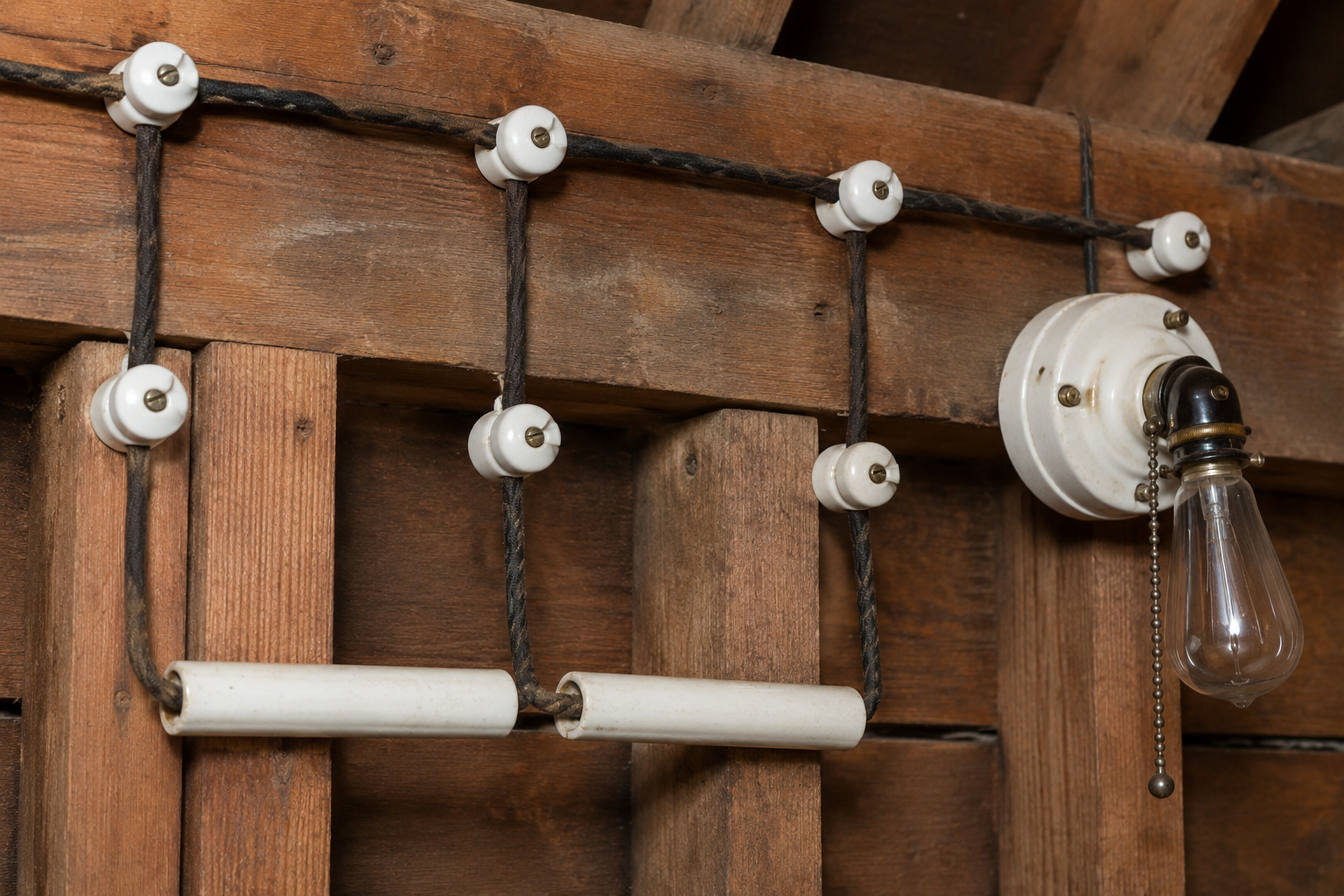
Ceramic knobs that hold wires in place along framing
Ceramic tubes that protect wires where they pass through wood
Individual insulated conductors separated in open air
This open-air design was intentional. It allowed heat to dissipate naturally, which helped prevent overheating under the relatively low electrical loads of the time. Unfortunately, with age and heat cycling, this wring degrades and becomes brittle and cracked.
Unlike modern wiring, knob-and-tube systems do not include a grounding conductor. That difference becomes important when evaluating compatibility with today’s appliances and safety expectations.
Why It Is Common in Denver
Denver saw significant residential growth between the late 1800s and the start of World War II. Many homes built during that period still exist today, particularly in central and historic neighborhoods.
Areas where knob-and-tube wiring is more frequently encountered include:
Capitol Hill
Baker
Five Points
Whittier
Congress Park
City Park
Early sections of Park Hill
Highlands and West Highlands
Wash Park and East Wash Park
Original areas of University Park
Not every home in these neighborhoods contains knob-and-tube wiring, but the likelihood increases with the age of the structure. In many cases, portions of the original system remain even after partial updates.
How the System Was Originally Intended to Function
When installed, knob-and-tube wiring performed well within its design limits. Homes at that time had far fewer electrical demands.
Typical characteristics of early electrical use included:
Minimal lighting loads
Few, if any, large appliances
Limited number of circuits per home
Because the wiring was suspended in open air, heat buildup was rarely an issue under these conditions. The system was simple, effective, and appropriate for its time.
The challenge today is that modern households place significantly greater demand on electrical systems.
How Modern Electrical Demand Changes the Equation
Electrical usage in homes has increased dramatically over the past several decades. Air conditioning systems, kitchen appliances, home offices, and electronics all contribute to higher and more continuous loads.
Knob-and-tube wiring was not designed for:
High-amperage appliances
Continuous heavy electrical draw
Dense circuit usage across multiple rooms
This does not automatically mean failure, but it does mean the system is often operating outside its original assumptions. That shift is one of the primary reasons evaluation becomes important.
Common Conditions That Raise Concern
In most inspections, the primary issues are not the original installation itself but what has changed since then.
Added Electrical Loads
Modern devices increase current demand on circuits that were originally intended for lighting and small loads. Over time, this can stress conductors and connections.
Insulation Contact
Knob-and-tube wiring depends on open air to dissipate heat. When attic or wall insulation is added over the wiring, that cooling effect is reduced.
This is a common condition in Denver, where energy upgrades often include added insulation. When active knob-and-tube wiring is buried, the potential for overheating increases.
Alterations and Splices
Few homes with knob-and-tube wiring remain untouched. Over decades, modifications are almost always present.
Common examples include:
Splices made outside of junction boxes
Transitions between old and modern wiring
Abandoned wiring that may still be energized
Improper alterations are often the most significant concern. The original system, when intact, is typically more predictable than one that has been repeatedly modified.
Lack of Grounding
The absence of a grounding conductor affects how the system interacts with modern electrical equipment.
This can impact:
Surge protection performance
Safety of certain appliances
Compatibility with current electrical standards
Grounding does not change how the system operates day to day, but it does influence overall safety and resilience.
Overfusing
When fuses have been replaced with higher-amperage ones than the wiring was originally rated to handle. When this situation occurs:
· The wire itself becomes the "fuse"
· It overheats silently, inside walls and ceilings
· The fuse never trips because the overcurrent never reaches the fuse’s inflated rating
· Heat builds at connections, splices, and anywhere resistance is higher
What Does Not Automatically Indicate a Hazard
One of the most common misconceptions is that the presence of knob-and-tube wiring alone means a home is unsafe.
In reality, risk depends on several factors:
Condition of the wire insulation
Amount of electrical load on the circuits
Quality of past modifications
Whether the wiring is covered by insulation
Some systems remain functional and relatively stable. Others, particularly those that have been heavily altered, present more significant concerns.
A clear evaluation focuses on condition and context rather than age alone.
Repair Versus Replacement: What Typically Happens
There is no single approach that applies to every home. Decisions are usually based on access, renovation plans, and the condition of the existing system.
Common strategies include:
Rewiring high-demand areas such as kitchens
Isolating older circuits from newer systems
Incremental upgrades over time
Full replacement during major renovations
Full replacement is often the most practical when walls and ceilings are already open. In finished homes, targeted improvements are more common.
Insurance and Real Estate Considerations
Knob-and-tube wiring often comes up during real estate transactions. Insurance carriers may have specific requirements depending on the extent and condition of the system.
Some providers:
Request documentation of evaluation
Require partial or full upgrades
Decline coverage until changes are made
These requirements vary widely. From a transaction standpoint, the presence of knob-and-tube wiring is less about immediate failure and more about how it affects insurability and long-term planning.
When Further Evaluation Is Recommended
An electrical evaluation is typically advised when certain conditions are observed.
These include:
Brittle or deteriorated wire insulation
Frequent circuit breaker trips or fuse issues
Lights dimming under load
Evidence of extensive modifications
Active wiring buried in insulation
These signs do not always indicate imminent failure, but they do suggest that a closer look is warranted.
Note: Homes with original knob-and-tube wiring are almost universally equipped with fuse panels, not circuit breakers. If you are observing repeated fuse issues in one of these homes, that pattern warrants closer evaluation of circuit loading and the condition of the wiring itself.
Inspector Insight
In Denver homes, it is common to find knob-and-tube wiring that has been partially updated rather than fully replaced. One circuit may be modern while another remains original, and transitions between the two are often where concerns arise.
A frequent issue during inspections is not the visible wiring itself, but what cannot be easily seen. Hidden splices, buried conductors, and undocumented changes tend to create more uncertainty than intact original runs.
Another pattern is insulation added over active wiring in attics. This is typically done during energy upgrades without realizing the impact on heat dissipation. It is one of the more consistent conditions that warrants further evaluation.
A fuse panel showing 30-amp fuses on general lighting and receptacle circuits is a significant red flag. This overfusing condition may have caused cumulative heat damage to wiring that now appears intact but is compromised at connections and splice points. This condition is not always visible during a standard inspection.
Practical Implications
For buyers, the presence of knob-and-tube wiring should be viewed as a condition to understand rather than a reason to immediately walk away. The key is determining how much of the system remains and how it has been modified.
For homeowners, the system often becomes part of a longer-term upgrade plan. Full replacement may not be urgent, but targeted improvements can reduce risk and improve functionality over time.
For agents, the conversation is often less about safety in the moment and more about insurance, negotiation, and future cost considerations.
In all cases, context matters. A well-maintained system with minimal alteration presents a very different picture than one that has been heavily modified over decades.
Author
Andrew Sams is the founder of Alpine Building Performance, a Denver based residential and commercial inspection firm. He holds a B.S. in Building Science and has over 15 years of experience in building diagnostics, energy auditing, and property condition assessment.
Andrew is a Certified Master Inspector (CMI), Certified Commercial Property Inspector (CCPI), and Radon Measurement Specialist. He was named the Denver Metro Association of Realtors 2022 Industry Partner of the Year and teaches continuing education courses for real estate professionals throughout Colorado.