
Polybutylene Plumbing in Colorado Homes
Polybutylene Plumbing in Colorado Homes: What Buyers Should Know
Polybutylene plumbing is one of those home inspection findings that can create immediate concern during a real estate transaction. The pipes may not be leaking. The water pressure may seem acceptable. Fixtures may operate normally. Yet the presence of polybutylene piping can still raise important questions about long-term reliability, insurance, replacement planning, and future water damage risk.
Polybutylene, often abbreviated as PB, was a flexible plastic water supply piping material installed in many homes from roughly the late 1970s through the mid-1990s. It was marketed as a lower-cost, easier-to-install alternative to copper plumbing. Over time, however, widespread concerns developed around premature failures, internal deterioration, and leakage. InterNACHI notes that deterioration can occur from within and may not be detectable during a standard home inspection without dismantling the pipe, which is outside normal inspection practice.
In Colorado, polybutylene is most often encountered in homes built or remodeled during the suburban growth period of the 1980s and early 1990s. It may appear in water distribution lines, basement ceilings, crawlspaces, mechanical rooms, under sinks, near water heaters, or at the main water service entry.
The concern is not simply that the material is old. The concern is that visible condition does not always reveal remaining reliability.
A home with polybutylene plumbing may function normally at the time of inspection, but buyers should understand why the material is treated differently from copper, PEX, or other modern plumbing systems.
Key Takeaways
Polybutylene piping was commonly installed in homes from roughly the late 1970s through the mid-1990s.
The material may deteriorate internally, meaning pipes can appear serviceable while still carrying increased failure risk.
Polybutylene is often found in Colorado homes built or remodeled during the 1980s and early 1990s.
A standard home inspection can identify visible polybutylene piping but cannot determine the condition of concealed piping inside walls, ceilings, or floors.
Insurance, replacement cost, prior leakage history, and buyer risk tolerance all matter when evaluating a home with polybutylene.
Full replacement is often recommended as the long-term solution when active polybutylene distribution piping is present.
What polybutylene plumbing is
Polybutylene is a flexible plastic resin piping material that was used for residential water supply systems. It was commonly installed because it was less expensive than copper, easier to route through framing, and faster to install.
The piping is usually found in smaller residential water distribution sizes, commonly serving fixtures such as sinks, tubs, showers, toilets, laundry connections, and water heaters.
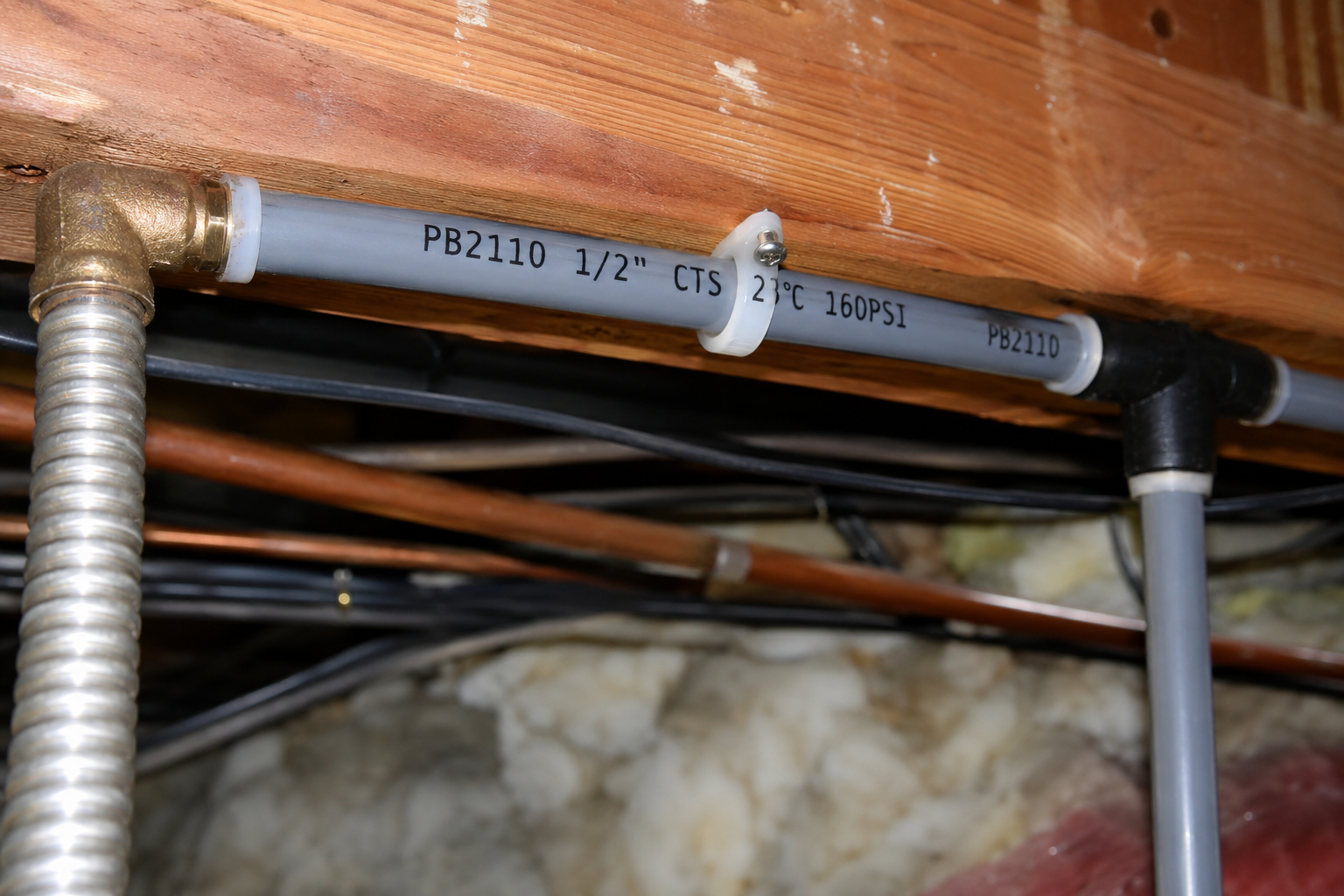
Polybutylene is most commonly gray, but it may also be blue, black, or occasionally other colors depending on the application. The pipe may be stamped with markings such as “PB” or “PB2110.”
Because it can resemble other plastic piping at a glance, correct identification matters. Polybutylene should not be confused with modern PEX piping, which has different performance characteristics and remains widely used today.
Why polybutylene became a concern
The concern with polybutylene is long-term reliability.
Over time, failures were reported in many systems. The commonly cited concern is that chemicals used in municipal water treatment, such as chlorine, may contribute to degradation of the piping material or fittings from the inside. Because the deterioration may happen internally, the pipe can look acceptable from the outside until a leak occurs.
That is the most difficult part of evaluating polybutylene during an inspection. A visible section of pipe may not show active leakage, but that does not confirm the condition of the material throughout the home.
This is similar to other inspection findings where function on the day of inspection does not fully answer the reliability question. A Federal Pacific electrical panel may power the home, but the concern is breaker performance under fault conditions. A knob-and-tube circuit may still operate, but its long-term safety depends on condition, modification, and loading. Polybutylene has a similar “working does not necessarily mean low risk” pattern.
Why polybutylene shows up in Colorado homes
Colorado experienced significant suburban development during the same period when polybutylene was commonly used.
Homes built in the 1980s and early 1990s in Denver-area suburbs, Front Range communities, and expanding neighborhoods may contain this material, especially if they have not had major plumbing replacement since construction.
It may also appear in older homes that were remodeled during that period. For example, a Denver home built in the 1950s may have had plumbing updates completed in the 1980s that introduced polybutylene in bathrooms, kitchens, basements, or additions.
Common places where polybutylene may be visible include:
Unfinished basement ceilings
Crawlspaces
Mechanical rooms
Near water heaters
Under sinks
Laundry rooms
Utility areas
Main water entry areas
Exposed piping near shutoff valves
In finished homes, much of the piping may be concealed behind walls and ceilings. That makes it difficult to determine the full extent of the system from visible areas alone.
How inspectors identify polybutylene
Inspectors typically identify polybutylene visually where piping is accessible.
Common identification clues include:
Gray flexible plastic water piping
Blue or black exterior service piping in some cases
Stamped markings such as “PB” or “PB2110”
Crimp rings or older plastic fittings
Installation era consistent with late 1970s through mid-1990s construction
Visible pipe routing through unfinished basements or crawlspaces
The markings are especially helpful because color alone is not always enough. Some gray piping may not be polybutylene, and some modern materials may look similar to buyers who are unfamiliar with plumbing systems.
If the material cannot be confidently identified, evaluation by a licensed plumber may be recommended.
The role of fittings and connections
Polybutylene systems may include different types of fittings depending on the installation period and system design.
Some early installations used plastic fittings. Later systems may include copper or brass fittings with crimp rings. Failures can occur at fittings, pipe sections, or connections.
Common concerns include:
Leaks at fittings
Cracked plastic connectors
Poorly crimped connections
Stress at bends or supports
Discoloration or staining near joints
Evidence of prior repairs
Mixed material repairs using newer piping
A home may also have partial repairs where sections of failed polybutylene were replaced with copper, PEX, or other materials. Partial repair may address a specific leak, but it does not eliminate the risk from remaining active polybutylene elsewhere in the home.
Why visible condition does not tell the whole story
One of the most important points for buyers is that polybutylene cannot be evaluated the same way as many other visible plumbing defects.
If a sink drain is leaking, that defect can often be directly observed. If a galvanized pipe is heavily corroded, visible deterioration may provide useful context. With polybutylene, the concern may exist even when the visible surface looks normal.
The pipe can appear:
Clean
Dry
Flexible
Properly supported
Free of corrosion
Free of visible staining
That does not necessarily confirm that the system is reliable.
A standard home inspection does not include cutting open pipe, pressure testing beyond normal fixture operation, or opening walls to inspect concealed sections. For that reason, inspection findings usually focus on identifying the material and explaining the implications.
Common signs of polybutylene problems
Although polybutylene may fail without obvious warning, some signs can suggest past or current problems.
These include:
Water stains on ceilings or walls
Evidence of previous plumbing repairs
Pipe patches or replaced sections
Staining below fittings
Dampness in cabinets or mechanical rooms
Low water pressure in some areas
Mold-like growth near plumbing areas
Swollen baseboards or flooring
Unexplained musty odors
Seller disclosures mentioning prior leaks
These signs do not prove that polybutylene has failed throughout the home, but they add context.
A home with polybutylene and a history of leaks should be evaluated more cautiously than a home where the material is present but no evidence of prior leakage is visible.
Polybutylene and insurance considerations
Polybutylene can affect insurance.
Insurance requirements vary by carrier, market conditions, state, property history, and the extent of piping present. Some insurers may provide coverage without issue. Others may ask questions, exclude certain water damage claims, charge differently, or require replacement before issuing or renewing a policy.
Buyers should not assume the home will be treated the same by every insurer.
When polybutylene is identified during inspection, buyers should contact their insurance provider before closing to confirm whether coverage will be available and whether any requirements apply.
This is especially important because insurance concerns can affect the transaction even when the system is not actively leaking.
Replacement versus monitoring
When active polybutylene water distribution piping is present, full replacement is often recommended as the most reliable long-term solution.
Monitoring may seem appealing if no leaks are visible, but monitoring has limitations. Because failures can occur inside walls, ceilings, or finished areas, a leak may not be discovered until damage has already occurred.
Replacement usually involves repiping the home with modern materials such as PEX or copper. The scope depends on the layout of the home, accessibility, number of fixtures, finished surfaces, and whether the main service line is also affected.
Partial replacement may reduce risk in specific areas, but it can leave remaining polybutylene in service.
For buyers, the question is less about whether replacement will eventually be needed and more about when, how much it may cost, and whether it should be addressed before or after closing.
Cost considerations
The cost of replacing polybutylene plumbing varies widely.
Factors that influence cost include:
Size of the home
Number of bathrooms
Number of plumbing fixtures
Basement or crawlspace access
Finished walls and ceilings
Type of replacement material
Local labor rates
Need for drywall repair or repainting
Whether the main service line is included
Whether the home is occupied during work
Repiping a home is more involved than replacing one visible pipe section. It often includes opening walls or ceilings, routing new distribution piping, reconnecting fixtures, and restoring finishes.
Because costs vary so much, buyers should obtain contractor estimates rather than relying on broad assumptions.
Polybutylene in remodeled homes
Remodeled homes can be especially confusing.
A home may have new finishes, updated bathrooms, modern fixtures, and renovated kitchens while still containing older polybutylene piping behind the walls.
In some cases, the visible plumbing under sinks has been updated, but concealed distribution piping remains original. In other cases, one bathroom or addition has been repiped while other areas still contain polybutylene.
This is why visible remodel quality should not be used as proof that plumbing has been fully updated.
During inspections, unfinished basements, crawlspaces, mechanical rooms, and water heater areas often provide the best clues about what materials remain in use.
Polybutylene service lines
Polybutylene may also be present in underground water service lines between the home and the municipal water connection.
These lines may be blue, black, or gray and may not be visible except near the main water entry, meter pit, or crawlspace penetration.
Service line concerns are important because exterior water service replacement can involve excavation, landscaping disruption, driveway or sidewalk issues, and municipal coordination.
A standard home inspection may not confirm the entire service line material. If visible material suggests a polybutylene service line, further evaluation by a plumber or utility specialist may be appropriate.
What buyers should ask
When polybutylene is identified, buyers should gather as much information as possible before closing.
Useful questions include:
How much of the plumbing system is polybutylene?
Is it limited to visible areas, or does it likely serve the full home?
Have there been prior leaks?
Are there plumbing repair invoices?
Has any portion of the home been repiped?
Is the main water service line also polybutylene?
Will insurance cover the home with this piping present?
What would replacement cost?
Are there finished areas where access would be difficult?
These questions help buyers separate a manageable planning issue from a larger transaction concern.
What a home inspection can and cannot determine
A home inspection can identify visible polybutylene piping where accessible. It can also document evidence of leakage, prior repairs, staining, or water damage.
However, a home inspection cannot:
See concealed piping inside finished walls
Determine internal pipe condition
Predict exactly when a pipe may fail
Confirm whether all polybutylene has been removed
Pressure test the system beyond normal operation
Guarantee insurability
Estimate replacement cost with precision
This limitation is important. The inspection can identify the material and explain why it matters, but it cannot certify the remaining useful life of the system.
When further evaluation may be appropriate
Further evaluation by a licensed plumber is commonly recommended when:
Polybutylene piping is visible
The extent of the material is unclear
Prior leaks or repairs are observed
Water staining is present
The home has been partially remodeled
The main service line may be polybutylene
The buyer wants a replacement estimate before closing
Insurance coverage may depend on replacement
Further evaluation does not always mean the plumbing is actively failing. It helps clarify the extent of the system, replacement options, and risk.
Inspector Insight
During inspections in Colorado homes, polybutylene is often found in houses built during the 1980s and early 1990s or in older homes remodeled during that period.
One of the most common buyer reactions is confusion because the plumbing may appear to be working normally. Fixtures run, drains operate, and no active leakage is visible. That normal operation is useful information, but it does not remove the concern.
The issue with polybutylene is not day-to-day function at the time of inspection. The concern is long-term reliability and the possibility of concealed failure.
Another common pattern is partial replacement. A plumber may have replaced a failed section with PEX or copper years earlier, leaving the rest of the system in place. That repair history is important because it may indicate that the material has already begun to create problems.
From an inspection standpoint, the goal is not to create alarm. It is to help buyers understand that polybutylene is a known risk material and should be evaluated differently from a routine plumbing maintenance item.
Practical implications for homeowners and buyers
For homeowners, the presence of polybutylene should prompt planning. Even if the system is not actively leaking, replacement may be worth considering before a failure causes water damage or before the issue complicates a future sale.
For buyers, polybutylene should be treated as a material condition with financial and insurance implications. It does not necessarily mean the home should be rejected, but it should be understood before closing. Replacement cost, insurance availability, prior leak history, and risk tolerance all matter.
For agents, polybutylene can affect negotiations because it is not always a simple repair request. It may involve full-system replacement, access to finished areas, insurance questions, and buyer comfort. Clear explanation helps keep the conversation grounded in risk rather than fear.
The bottom line
Polybutylene plumbing is a known concern in Colorado homes built or remodeled during the late 1970s through mid-1990s.
The pipes may look normal and function properly during a home inspection, but visible condition does not reliably determine long-term performance. The primary concern is internal deterioration, concealed leakage, and future failure risk.
A standard home inspection can identify visible polybutylene piping and related signs of leakage or repair, but it cannot determine the condition of concealed piping or predict when failure may occur.
For buyers, the best approach is to understand the extent of the material, confirm insurance implications, obtain replacement estimates when appropriate, and make an informed decision before closing.
Author
Andrew Sams is the founder of Alpine Building Performance, a Denver based residential and commercial inspection firm. He holds a B.S. in Building Science and has over 15 years of experience in building diagnostics, energy auditing, and property condition assessment.
Andrew is a Certified Master Inspector (CMI), Certified Commercial Property Inspector (CCPI), and Radon Measurement Specialist. He was named the Denver Metro Association of Realtors 2022 Industry Partner of the Year and teaches continuing education courses for real estate professionals throughout Colorado.