
Poor Drainage and Foundation Problems in Denver Homes
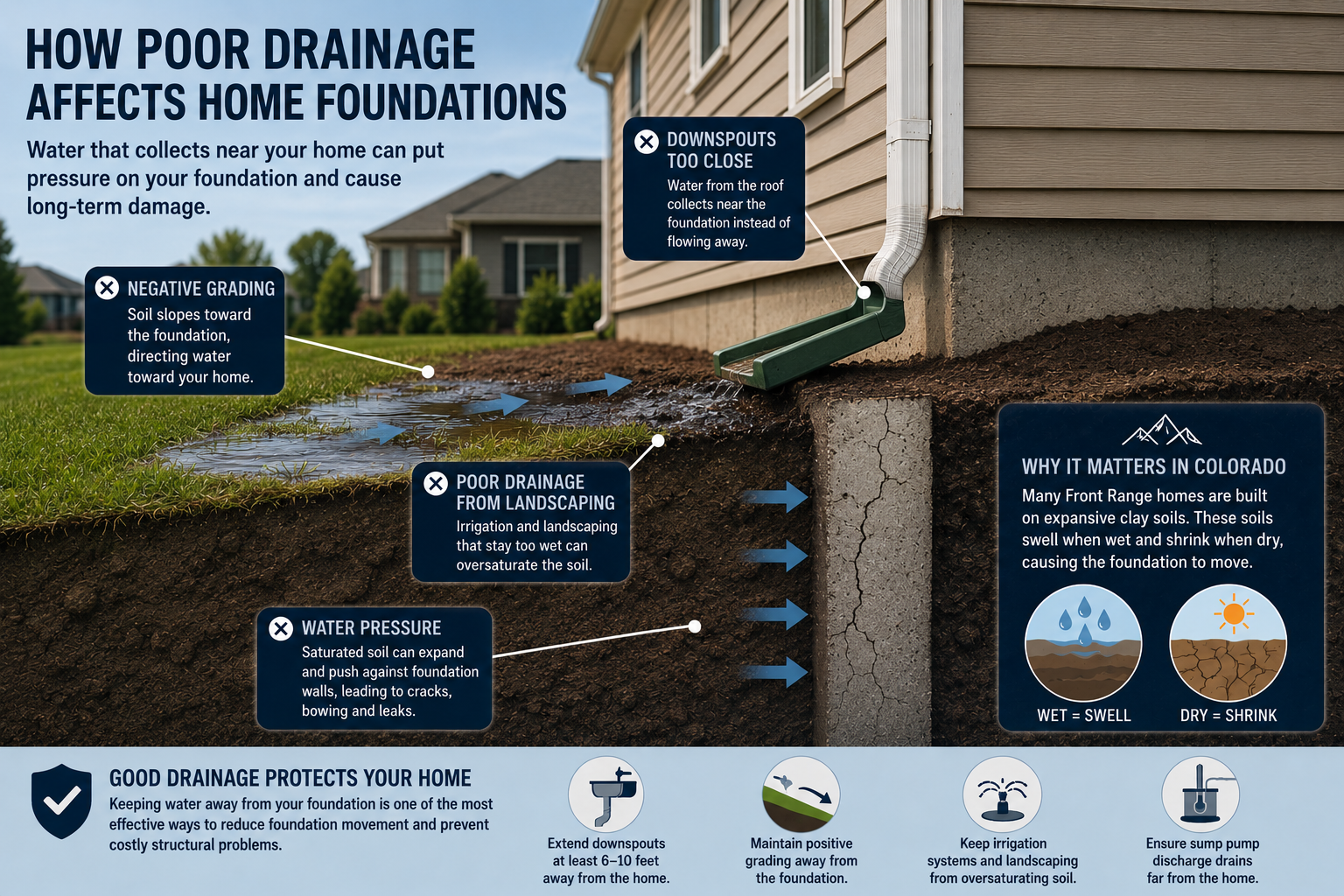
How Poor Drainage Affects Home Foundations
Poor drainage is one of the most common contributors to foundation movement, basement moisture, crawlspace problems, and long-term structural stress in homes along the Colorado Front Range.
In many cases, drainage problems are not dramatic. They may start with a disconnected downspout, soil that slopes toward the house, clogged gutters, or irrigation that runs too close to the foundation. Over time, these small moisture issues can change the way the soil around a home behaves.
That matters because foundations do not exist in isolation. They rely on the surrounding soil for support. When water collects near the foundation, the soil can expand, soften, erode, or apply pressure against basement and crawlspace walls.
In the Denver metro area, this issue is especially important because many homes are built on expansive clay soils. These soils swell when wet and shrink when dry, which makes consistent moisture management one of the most important factors in long-term foundation performance. This connects closely with the foundation movement patterns discussed in your expansive clay soils article.
Poor drainage does not automatically mean a home has structural damage. But it does increase the likelihood of foundation movement, basement water intrusion, crawlspace moisture, and recurring maintenance concerns.
Key Takeaways
Poor drainage is one of the most common exterior conditions that contributes to foundation movement.
Water collecting near the foundation can increase soil pressure, cause expansive soils to swell, and create uneven support beneath the structure.
In Denver and along the Front Range, expansive clay soils make drainage especially important.
Gutters, downspouts, grading, hardscape slope, irrigation, and sump discharge all affect foundation performance.
Correcting drainage problems early is often one of the most effective ways to reduce long-term foundation stress.
Why drainage matters so much around foundations
A foundation depends on stable soil conditions. When the soil around a home stays relatively consistent, the foundation is more likely to remain stable over time.
Problems develop when moisture levels change unevenly.
If one side of a home receives heavy roof runoff while another side remains dry, the soil may expand or contract at different rates. That uneven movement can create stress on the foundation system.
In basement homes, wet soil can also push laterally against foundation walls. This pressure may contribute to horizontal cracking, wall bowing, or moisture intrusion. In crawlspace homes, wet soils can affect perimeter stem walls, interior piers, posts, and wood framing.
The issue is not just the amount of water. It is where the water goes, how often it collects, and whether it drains away from the structure.
How Colorado soils make drainage more important
Many areas along the Front Range contain clay-rich soils. These soils behave differently than sandy or gravelly soils because they hold water and change volume as moisture levels fluctuate.
When expansive clay soils absorb water, they swell. When they dry out, they shrink. This repeated cycle can place stress on foundation walls, footings, slabs, crawlspaces, and interior finishes.
This is why drainage is such a consistent theme in Denver-area inspections. A home may have a well-built foundation, but if water is repeatedly directed toward the structure, the soil conditions around that foundation can become unstable.
Common drainage-related soil behaviors include:
Soil swelling against basement walls
Shrinkage during dry periods
Uneven support beneath slabs or footings
Lateral pressure against foundation walls
Settlement where soils soften or erode
Seasonal movement that repeats year after year
This is also why foundation cracking is common in the Denver area. The presence of cracks alone does not always indicate a serious structural problem, but drainage conditions help explain whether movement is likely to continue.
Common drainage problems found during home inspections
Drainage problems usually come from a combination of small exterior conditions rather than one major failure.
Downspouts discharging too close to the foundation
This is one of the most common findings during inspections.
Gutters collect a large amount of roof water. If downspouts discharge near the foundation, that water concentrates in a small area beside the home.
Over time, this can saturate the soil, increase foundation wall pressure, contribute to basement seepage, and worsen expansive soil movement.
Downspout extensions are simple, but they are often missing, disconnected, crushed, or poorly positioned.
Negative grading
Negative grading occurs when soil slopes toward the house instead of away from it.
When this happens, rainwater and snowmelt naturally move toward the foundation. Even if gutters are functioning properly, poor grading can still trap water near the home.
A common drainage guideline is to maintain positive slope away from the foundation where site conditions allow. In many cases, this means the soil should drop several inches within the first several feet away from the home.
Settled soil near the foundation
Soil often settles around a home over time, especially near backfilled foundation walls.
This can create low areas that collect water close to the structure. These depressions are easy to overlook because they may not appear significant when the soil is dry.
During storms or snowmelt, however, these low spots can hold water directly beside the foundation.
Clogged or undersized gutters
Gutters must be able to collect and move roof runoff effectively.
When gutters are clogged with leaves, granules, or debris, water can spill over the edge and fall directly beside the foundation. This often creates concentrated moisture along basement walls or crawlspace perimeters.
Undersized gutters or poorly pitched gutter runs can create similar problems during heavy rain.
Hard surfaces sloping toward the home
Driveways, patios, sidewalks, and concrete flatwork can either help or hurt drainage.
When these surfaces slope toward the house, they direct water toward the foundation. In some cases, settled concrete creates a channel that sends water into window wells, basement walls, or crawlspace openings.
This is especially common where older patios or sidewalks have settled over time.
Irrigation too close to the foundation
Sprinkler systems can create drainage problems when heads spray against the house or when irrigation zones keep soil near the foundation consistently wet.
This is particularly important in Colorado because homeowners may irrigate heavily during dry periods. If irrigation is uneven, one side of the foundation may remain wetter than another, increasing the potential for differential soil movement.
Basement foundations and poor drainage
Basements are especially sensitive to poor drainage because the foundation walls extend below grade and are directly exposed to surrounding soil.
When water accumulates near basement walls, several things can happen.
First, soil pressure increases. Wet clay soil can expand and push inward against the foundation wall. Over time, this pressure may contribute to horizontal cracking, inward bowing, or wall displacement.
Second, water may find pathways into the basement. Even small cracks, pipe penetrations, window wells, or wall-floor joints can allow moisture entry when exterior conditions are saturated.
Third, recurring moisture can create secondary concerns such as efflorescence, musty odors, damaged finishes, mold growth, or reduced indoor air quality.
Not every damp basement indicates a structural problem. But recurring moisture near basement walls is a sign that drainage conditions should be evaluated.
Crawlspaces and drainage concerns
Crawlspaces are often affected by drainage in less obvious ways.
When water collects around or beneath a crawlspace, humidity levels can rise. Elevated crawlspace moisture may contribute to mold growth, wood deterioration, pest activity, insulation damage, and musty indoor odors.
Poor drainage can also affect interior supports. Crawlspace piers, posts, and beams rely on stable support conditions. If soils below these supports soften, shift, or heave, uneven floors may develop above.
Because crawlspaces are often out of sight, drainage-related problems may go unnoticed for long periods.
Signs of crawlspace drainage problems may include:
Damp soil
Standing water
Wet or damaged insulation
Musty odors
Rusted metal connectors
Wood staining or decay
Mold-like growth on framing
Uneven or sloping floors above
Moisture control in crawlspaces often requires a combination of exterior drainage improvements, vapor barriers, ventilation or encapsulation strategies, and correction of any plumbing leaks.
Drainage and basement wall cracks
Poor drainage is not the only cause of basement wall cracks, but it is one of the most important contributing factors.
In Denver-area homes, basement cracks often reflect the interaction between soil moisture and foundation walls. Vertical cracks may be related to normal shrinkage or minor settlement. Horizontal cracks, stair-step cracks, widening cracks, or bowing walls deserve more attention because they may indicate soil pressure or structural movement.
Drainage conditions help determine whether a crack is likely to remain stable or continue changing.
For example, a small vertical crack in a poured concrete wall may be relatively low concern if the surrounding drainage is well managed and there is no displacement. That same crack may deserve closer attention if a downspout discharges directly above it, the soil slopes toward the wall, and moisture staining is present inside.
The crack pattern matters, but so does the exterior water pattern.
Window wells and localized drainage problems
Window wells are a common source of basement water problems.
A properly installed window well should be clear of debris, drain effectively, and keep water away from the window opening. When wells fill with leaves, soil, snow, or roof runoff, they can trap water against the basement window.
This can lead to leakage through the window frame, damage to interior finishes, or moisture staining below the window.
Window well problems often occur when:
Downspouts discharge nearby
Grading slopes toward the well
The well drain is clogged or missing
The well cover is absent or damaged
Soil has built up inside the well
The top of the well sits too low relative to surrounding grade
Because window wells create openings below grade, they deserve careful attention during drainage evaluation.
Sump pumps and drainage discharge
Sump pumps are designed to collect and remove water from around or beneath the foundation.
However, sump discharge can create problems if it terminates too close to the house. When discharged water flows back toward the foundation, the system may end up recycling the same water repeatedly.
Proper sump discharge should direct water away from the structure to an appropriate drainage location.
In cold climates, discharge lines also need to be protected from freezing. A frozen discharge line can prevent the sump pump from removing water when it is needed most.
A sump pump can be a helpful part of a drainage strategy, but it should not be viewed as a substitute for proper exterior grading, roof drainage, and surface water management.
Why drainage problems are often seasonal
Drainage problems may not be visible during every inspection.
A home inspected during a dry period may show limited evidence of moisture even if drainage problems exist. During spring snowmelt, summer storms, or prolonged wet weather, those same conditions may become much more obvious.
In Colorado, freeze-thaw cycles also play a role. Snow may accumulate around the foundation, melt during warmer daytime temperatures, and refreeze overnight. Repeated cycles can keep soils near the home wet for extended periods.
This seasonal pattern is one reason inspectors look closely at drainage conditions even when no active water intrusion is visible at the time of inspection.
What inspectors look for
During a home inspection, drainage is evaluated by looking at how water is likely to move around the property.
Important observations include:
Gutter condition and debris
Downspout locations
Downspout extension length and direction
Soil slope near the foundation
Low spots beside the home
Settled patios, sidewalks, or driveways
Window well condition
Evidence of erosion
Moisture staining on foundation walls
Efflorescence or mineral deposits
Crawlspace dampness
Sump pump presence and discharge location
Irrigation patterns near the structure
The goal is not simply to identify whether water is present at that moment. The goal is to understand whether site conditions are likely to direct water toward or away from the foundation over time.
Common signs that drainage may already be affecting the home
Drainage issues often leave clues.
Exterior signs may include:
Soil erosion near downspouts
Mulch or landscaping washed away
Low areas near the foundation
Cracked or settled flatwork
Water stains on foundation walls
Algae or staining near grade
Damp window wells
Interior signs may include:
Basement moisture stains
Efflorescence on concrete or masonry
Musty odors
Damp carpet or baseboards
Peeling paint near lower walls
Mold-like growth in corners or closets
Crawlspace humidity
Sloping floors or interior cracks
No single sign proves that drainage has caused structural movement. But when several of these conditions appear together, drainage should be considered a likely contributor.
Correcting drainage problems
Drainage improvements are often straightforward, especially when addressed early.
Common corrective measures include:
Extending downspouts away from the foundation
Cleaning and maintaining gutters
Regrading soil so it slopes away from the house
Filling settled areas near the foundation
Adjusting irrigation heads and watering patterns
Improving window well drainage
Redirecting sump pump discharge
Repairing settled flatwork that directs water toward the home
Managing landscaping so mulch and soil do not trap moisture against siding or foundation walls
In more significant cases, drainage correction may involve exterior drain systems, foundation waterproofing, sump system improvements, or structural evaluation.
The appropriate solution depends on the source of the water and how it is affecting the home.
When further evaluation may be appropriate
Further evaluation may be recommended when drainage problems are associated with signs of structural movement or recurring water intrusion.
Examples include:
Horizontal basement wall cracks
Bowing or leaning foundation walls
Widening cracks
Persistent basement leakage
Standing water in crawlspaces
Repeated sump pump operation
Significant floor slope changes
Moisture damage to framing or finishes
In these cases, a qualified drainage contractor, foundation specialist, structural engineer, or waterproofing contractor may be appropriate depending on the condition observed.
Further evaluation does not automatically mean major repair is required. It helps determine whether the issue is primarily a drainage maintenance concern or part of a larger foundation performance problem.
Inspector Insight
During inspections throughout the Denver metro area, poor drainage is one of the most consistent exterior conditions connected to foundation and moisture concerns.
The most common pattern is not a catastrophic drainage failure. It is usually a combination of ordinary conditions: downspouts discharging too close to the home, settled soil near the foundation, clogged gutters, and hardscape that slopes the wrong direction.
These conditions often appear minor individually, but together they can keep soil near the foundation wetter than intended.
In homes built on expansive clay soils, that moisture pattern matters. Repeated wetting and drying can contribute to seasonal movement, basement wall stress, slab cracking, and crawlspace moisture.
One of the most important inspection takeaways is that drainage should be evaluated even when the basement is dry at the time of inspection. A dry day does not always reflect how the property performs during storms, snowmelt, or irrigation season.
Practical implications for homeowners and buyers
For homeowners, drainage maintenance is one of the most practical ways to reduce long-term foundation risk. Keeping gutters clean, extending downspouts, maintaining proper grading, and managing irrigation can significantly improve how the home performs over time.
For buyers, drainage conditions provide important context during the inspection process. Foundation cracks, basement moisture, or crawlspace concerns should be interpreted alongside exterior water management. Sometimes the most important recommendation is not immediate structural repair, but correcting the conditions that are contributing to movement or moisture.
For agents, drainage issues are common and often manageable. Clear explanations help keep inspection findings in perspective. Poor drainage deserves attention, but it does not automatically mean the home has a major foundation defect.
The bottom line
Poor drainage affects home foundations by changing the moisture conditions in the soil around the structure.
In the Denver metro area, where expansive clay soils are common, this matters significantly. Water collecting near the foundation can cause soils to swell, increase pressure against basement walls, contribute to crawlspace moisture, and create uneven support conditions beneath the home.
Many drainage issues are simple to correct when identified early. Downspout extensions, gutter maintenance, grading improvements, and irrigation adjustments can reduce long-term foundation stress.
The key is understanding that drainage is not just a landscaping issue. It is a foundation performance issue.
Author
Andrew Sams is the founder of Alpine Building Performance, a Denver based residential and commercial inspection firm. He holds a B.S. in Building Science and has over 15 years of experience in building diagnostics, energy auditing, and property condition assessment.
Andrew is a Certified Master Inspector (CMI), Certified Commercial Property Inspector (CCPI), and Radon Measurement Specialist. He was named the Denver Metro Association of Realtors 2022 Industry Partner of the Year and teaches continuing education courses for real estate professionals throughout Colorado.