
Stucco Problems in Colorado: Why Dry Climates Create Different Risks
Why Stucco Behaves Differently Along the Front Range
Stucco siding is often associated with moisture problems, but the way those problems develop depends heavily on climate. In wetter parts of the country, stucco failures are typically tied to frequent rain and bulk water intrusion. Along Colorado’s Front Range, the pattern is different.
Here, stucco issues tend to develop slowly. The climate does not keep walls consistently wet, but it does expose them to repeated cycles of heat, cooling, and intermittent moisture. These conditions create a different kind of stress on building materials.
In inspections, this often means that visible damage lags behind what is happening inside the wall. A stucco exterior can appear relatively intact while moisture-related deterioration develops beneath the surface.
Understanding the Two Types of Stucco
Not all stucco is the same system, and the distinction matters significantly when evaluating risk.
Traditional three-coat stucco is applied over metal lath and a weather-resistive barrier. It has an inherent drainage gap between the stucco and the sheathing, which allows limited moisture to move downward and escape. When properly installed and maintained, it is a reasonably forgiving system in most climates.
EIFS (Exterior Insulation and Finish System), sometimes called synthetic stucco, is a foam-based assembly that looks similar to traditional stucco but performs very differently. Early EIFS installations had no drainage layer, meaning any moisture that entered the system had no path out. This barrier-style EIFS has a well-documented history of concealed moisture damage and has been the subject of significant litigation and insurance issues across the country. Newer drainable EIFS systems address some of these concerns, but identification of the system type remains an important first step in any stucco evaluation.
Buyers and agents should confirm which system is present before drawing conclusions about risk. The advice throughout this article applies most directly to traditional three-coat stucco. EIFS warrants a separate, more cautious evaluation.
Why Climate Plays Such a Critical Role
Colorado presents a combination of environmental conditions that are not what traditional stucco assemblies were originally designed for.
Key factors include:
Low overall humidity
Intense solar exposure at high elevation
Large temperature swings between day and night
Regular freeze-thaw cycles
Occasional wind-driven rain and snow
Rather than experiencing long periods of saturation, stucco walls along the Front Range go through repeated wetting and drying cycles. Materials expand, contract, absorb small amounts of moisture, and then dry again.
Over time, this cyclical movement can open pathways for water to enter, even if those openings are not obvious.
How Stucco Is Intended to Perform
A common misconception is that stucco acts as a waterproof barrier. In reality, stucco is a water-managed cladding system.
That distinction matters.
A properly constructed stucco wall is designed to handle some moisture intrusion. When water gets behind the surface, the assembly should allow it to:
Drain downward
Dry outward
Evaporate between wetting events
Problems begin when this balance breaks down. If moisture enters but cannot drain or dry effectively, it can accumulate within the wall assembly.
The weather-resistive barrier (WRB) is the membrane installed directly behind the stucco and in front of the sheathing. It is the last line of defense against moisture reaching the structural components of the wall. Its continuity, condition, and whether it was correctly integrated with flashings at windows and penetrations are among the most important factors in how the system performs over time. A stucco wall with a compromised or missing WRB has no meaningful backup if moisture gets past the surface.
Trapped Moisture: The Most Common Issue in Colorado
In dry climates, moisture problems are often less about large leaks and more about small, repeated entry points that go unnoticed.
Common sources include:
Window flashing details
Roof-to-wall intersections
Deck and balcony attachments
Missing or blocked drainage paths
Because the climate allows for extended drying periods, these small amounts of moisture may not create immediate staining or visible damage. Instead, they remain trapped behind the stucco, gradually affecting sheathing and framing.
This slow progression is one of the defining characteristics of stucco issues in Colorado.
The Sheathing Beind the Stucco
The type of sheathing behind a stucco wall has a significant effect on how moisture damage progresses. Plywood, which was standard in most homes built before the 1990s, has reasonable resistance to intermittent moisture exposure and tends to show deterioration more slowly.
OSB (oriented strand board) became a common sheathing material through the 1990s and 2000s and is considerably more vulnerable. When OSB is exposed to repeated moisture cycles, it can swell, delaminate, and lose structural integrity relatively quickly. Homes from that era with stucco cladding over OSB represent a higher-risk combination, particularly when any moisture management details are less than complete. This is directly relevant to buyers evaluating Front Range homes built during that period.
Thermal Movement and Cracking
Temperature variation along the Front Range is significant. It is not uncommon for surfaces to heat up dramatically during the day and cool rapidly at night.
This movement affects stucco in several ways:
Expansion and contraction create hairline cracks
Sealant joints around windows and penetrations begin to fail
Small gaps develop at transitions between materials
Many of these cracks are minor and expected. However, they can allow occasional moisture intrusion during certain weather conditions, particularly when combined with wind-driven precipitation.
Freeze-Thaw Cycles and Material Breakdown
When moisture is present within stucco, freeze-thaw cycles become a factor. Water expands as it freezes, which can stress the material from within.
Over time, this can lead to:
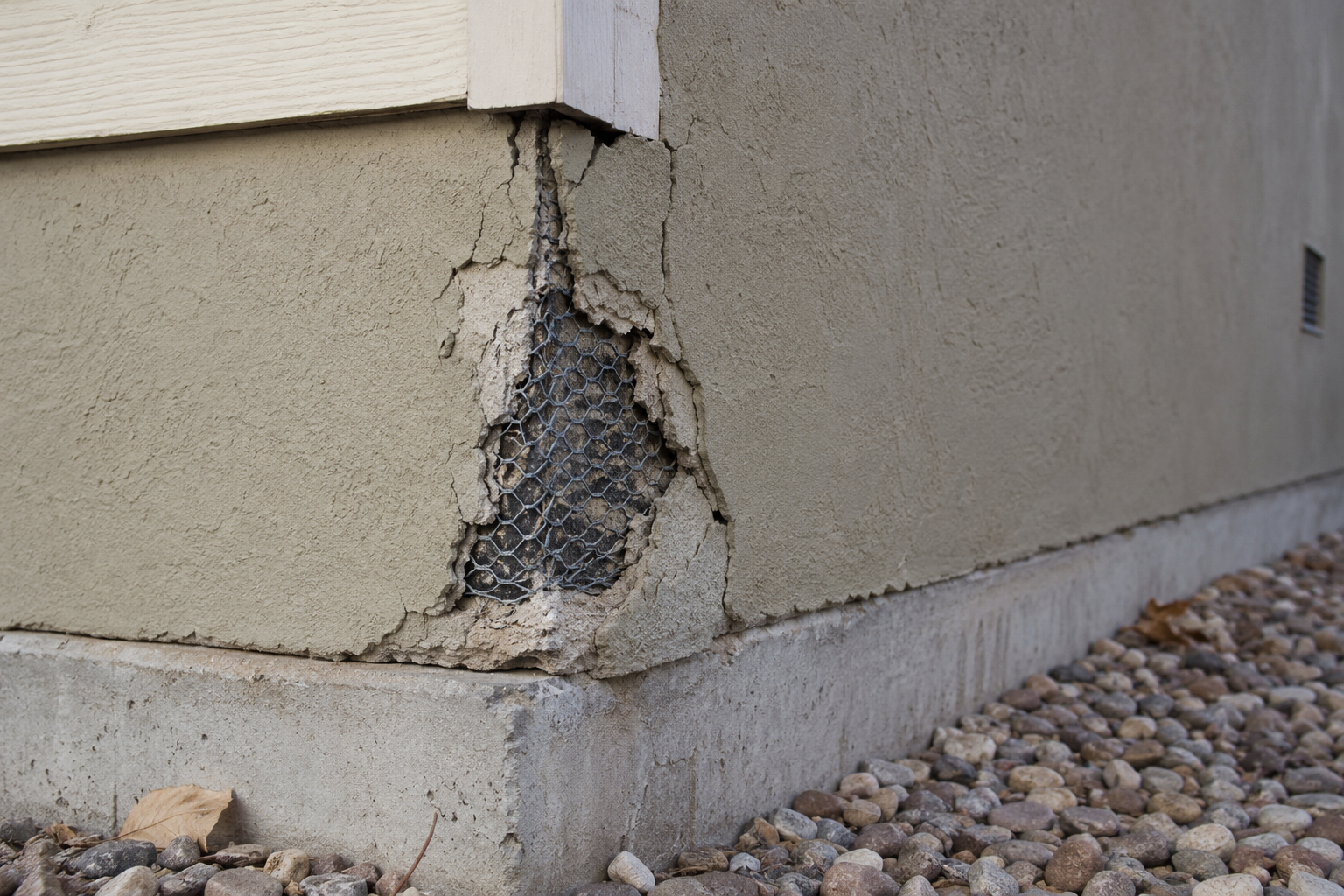
Surface spalling
Breakdown of coatings or finishes
Gradual widening of existing cracks
These effects are typically slow to develop, but they contribute to long-term deterioration when moisture is repeatedly introduced into the system.
Why Damage Often Remains Hidden
One of the more challenging aspects of stucco in Colorado is that visible symptoms often appear late.
Because walls have time to dry between moisture events:
Staining may be minimal or absent
Exterior surfaces can look intact
Interior symptoms may not appear immediately
Meanwhile, concealed areas such as sheathing or framing can experience prolonged exposure to intermittent moisture.
When concealed moisture is suspected, moisture probe testing is the standard method for evaluation. This involves inserting small probes through the stucco surface at strategic locations to measure moisture levels in the sheathing and framing behind the wall. It is a targeted, minimally invasive approach that can identify elevated moisture in areas that show no visible exterior symptoms. Buyers who have concerns about a stucco exterior, particularly on homes from the 1990s and 2000s, should consider requesting this type of evaluation as part of the inspection process.
How This Differs From Wet Climate Failures
The contrast between Colorado and wetter regions is important when interpreting stucco conditions.
In wetter climates:
Water intrusion happens more frequently
Damage tends to appear quickly
Staining and visible deterioration are common
In Colorado:
Moisture events are intermittent
Drying periods mask early warning signs
Damage develops gradually over time
The risk is not constant saturation, but rather repeated, low-level moisture exposure that goes unnoticed.
Why Newer Homes Are Not Immune
Stucco issues are often associated with older construction, but newer homes along the Front Range can experience similar problems.
Modern designs tend to include:
Complex wall geometries
Multiple material transitions
Larger and more numerous window openings
Each transition requires careful integration of flashing and drainage details. Small installation errors in these areas may not show immediate symptoms in a dry climate, allowing issues to develop slowly.
What Does Not Automatically Indicate a Problem
Not all cracking or surface variation in stucco is a sign of failure.
Hairline cracks are common and can result from:
Normal curing of the material
Expected thermal movement
Minor structural settling
These conditions are often cosmetic.
Concern increases when cracks:
Continue to widen over time
Occur at joints, penetrations, or transitions
Appear alongside signs of moisture inside the home
Context and progression matter more than the presence of minor cracking alone.
Typical Locations Where Problems Develop
Certain areas of a stucco exterior are more vulnerable due to how water interacts with the building.
Higher-risk locations include:
Window perimeters
Roof-to-wall intersections
Decks and balconies
Areas near grade or ground contact
Transitions between stucco and other materials
Grade termination deserves specific attention. Building code requires stucco to terminate a minimum of four inches above the finished grade. When stucco runs down to or below grade level, it wicks moisture from the soil continuously, bypassing the drainage system entirely. This is a common condition in older Front Range homes and one that creates persistent low-level moisture exposure at the base of the wall, regardless of how well the rest of the assembly performs.
Roof-to-wall intersections are another location where a single missing or improperly installed component causes disproportionate damage. Kick-out flashing, also called diverter flashing, is installed where a sloped roof meets a vertical wall to redirect water away from the wall surface rather than allowing it to run behind the cladding. Its absence is one of the most consistently observed contributors to concealed moisture damage in stucco walls, and it is worth confirming as part of any stucco evaluation.
Inspector Insight
In Front Range inspections, stucco rarely fails in obvious ways early on. More often, the exterior appears serviceable while subtle clues point to underlying issues.
One consistent pattern is cracking at window corners and along horizontal transitions. These areas experience the most movement and are also where flashing details are most critical. When sealants age or fail, small amounts of water can enter repeatedly without creating immediate staining.
Another observation is that moisture-related damage is often localized. A single elevation or wall section may show deterioration while adjacent areas remain unaffected. This usually reflects differences in sun exposure, drainage, or installation quality rather than a uniform failure of the entire system.
One field technique worth knowing is tapping the stucco surface and listening for a hollow sound. Areas where stucco has delaminated from the substrate, or where the substrate behind it has softened or deteriorated, will produce a distinctly different sound than sections that remain well bonded. This hollow-sound pattern does not always indicate active moisture, but it is a reliable indicator that the assembly behind that section warrants closer evaluation.
Identifying the stucco system type is also a consistent first step. Traditional three-coat stucco and EIFS require different evaluation approaches. When the system is unclear from visual inspection, a small probe test or consultation with a stucco specialist can clarify what is present before drawing conclusions about condition.
Practical Implications
For buyers, stucco should be evaluated as a system rather than judged by surface appearance alone. Minor cracking is common, but attention should be given to transitions, penetrations, and any signs of moisture intrusion.
For homeowners, maintenance plays an important role. Monitoring sealants, addressing cracks that change over time, and managing drainage around the home can significantly extend the life of the system.
For agents, stucco often raises concern due to its reputation in wetter climates. Providing context about how it performs in Colorado helps set more accurate expectations during transactions.
In all cases, understanding how moisture moves through and around the wall assembly is more important than focusing on the finish layer alone.
Author
Andrew Sams is the founder of Alpine Building Performance, a Denver based residential and commercial inspection firm. He holds a B.S. in Building Science and has over 15 years of experience in building diagnostics, energy auditing, and property condition assessment.
Andrew is a Certified Master Inspector (CMI), Certified Commercial Property Inspector (CCPI), and Radon Measurement Specialist. He was named the Denver Metro Association of Realtors 2022 Industry Partner of the Year and teaches continuing education courses for real estate professionals throughout Colorado.