Swamp Coolers vs. Central Air in Denver Homes: What Buyers Should Know
Background
Cooling systems in Denver homes can look very different from one property to another. Some homes have traditional central air conditioning. Others rely on evaporative coolers, commonly called swamp coolers. Some have both. Others have window units, mini-splits, or no dedicated cooling system at all.
For buyers moving from other parts of the country, swamp coolers can be unfamiliar. They may look outdated compared with central air conditioning, but in Colorado’s dry climate, they can be surprisingly effective when properly installed and maintained.
The key is understanding how each system works, what conditions they perform well in, and what limitations buyers should expect.
In Denver and along the Front Range, the cooling conversation is not simply about comfort. It also involves home age, ductwork, roof penetrations, water supply lines, winterization, electrical capacity, energy use, and how the system has been maintained over time.
A home inspection does not determine the full design performance of a cooling system, but it can identify visible defects, installation concerns, maintenance issues, and conditions that may affect operation.
Key Takeaways
Swamp coolers work well in dry climates because they cool air through evaporation.
Central air conditioning uses refrigerant and can provide more consistent cooling regardless of outdoor humidity.
Evaporative coolers are common in older Denver homes and can be effective, but they require seasonal maintenance and winterization.
Central AC may offer better comfort during humid periods, smoky days, poor outdoor air quality, or when windows need to remain closed.
Some homes converted from swamp coolers to central air still have leftover roof openings, ductwork changes, or abandoned equipment that should be evaluated.
The best system depends on the home, the occupant’s expectations, installation quality, and maintenance history.
Why swamp coolers are common in Colorado
Evaporative coolers are common along the Front Range because Colorado’s climate is generally dry.
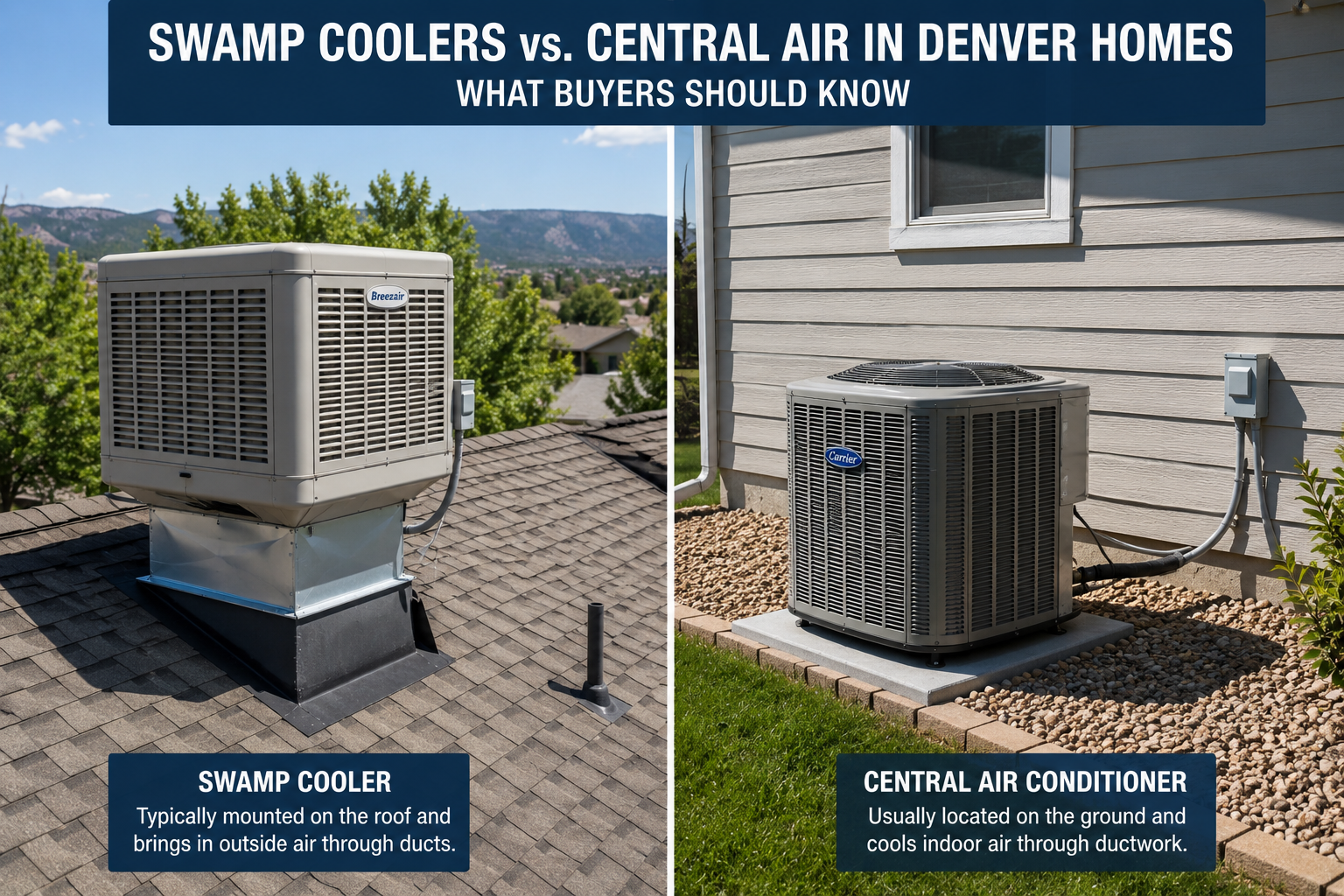
A swamp cooler works by pulling outdoor air through water-saturated pads. As water evaporates, it absorbs heat from the air, lowering the air temperature before it enters the home.
This process works best when outdoor air is hot and dry. That is why evaporative cooling can be effective in Denver, where summer humidity is often relatively low compared with many other regions.
In wetter climates, swamp coolers perform poorly because the air is already holding more moisture. In Colorado, the dry air allows more evaporation to occur, which creates the cooling effect.
This is why many older Denver homes were originally built or later retrofitted with evaporative coolers rather than central air conditioning.
How central air conditioning works differently
Central air conditioning cools the home using a refrigerant cycle.
Instead of adding moisture to the air, central AC removes heat from indoor air and transfers it outside through the outdoor condenser unit. The cooled air is then distributed through ducts.
Central air conditioning can control indoor temperature more consistently than a swamp cooler because it does not depend on dry outdoor air in the same way.
Central AC also removes some humidity from indoor air, which can improve comfort in humid conditions. That benefit is less important in Denver than in wetter climates, but it still matters during certain weather patterns, shoulder seasons, or homes with elevated indoor humidity.
In many homes, central AC is the more familiar and predictable cooling system for buyers.
The biggest performance difference: dry air vs. closed-house cooling
The most important difference between swamp coolers and central AC is how the home is operated.
A swamp cooler brings outdoor air into the home. For the system to work properly, air must also leave the home. That usually means windows or doors need to be partially open to allow airflow.
Central air conditioning works differently. It recirculates indoor air and cools it through the HVAC system. Windows and doors should remain closed during operation.
This difference affects comfort, indoor air quality, noise, security, and buyer expectations.
With a swamp cooler, occupants often need to manage airflow by opening windows strategically. With central AC, operation is usually more automatic and controlled through a thermostat.
Neither approach is automatically better. They are simply different systems with different operating assumptions.
Benefits of evaporative coolers in Denver
When properly maintained, a swamp cooler can provide several advantages in Denver’s climate.
Lower operating cost
Evaporative coolers generally use less electricity than central AC because they do not rely on a compressor. They typically use a fan, water pump, and water supply.
For homeowners trying to reduce summer cooling costs, this can be appealing.
Fresh air ventilation
Swamp coolers continuously bring in outdoor air rather than recirculating indoor air.
During good outdoor air quality conditions, this can make the home feel fresh and well-ventilated.
Simpler equipment
Evaporative coolers are mechanically simpler than central AC systems. They do not use refrigerant, compressors, or outdoor condenser coils.
This does not mean they are maintenance-free, but the components are generally straightforward.
Good performance in hot, dry weather
On dry summer days, a properly operating swamp cooler can make a home noticeably more comfortable.
For many Denver homes, especially older homes without existing central AC infrastructure, evaporative cooling has historically been a practical solution.
Limitations of swamp coolers
Swamp coolers also have important limitations.
They depend on outdoor humidity
Evaporative cooling becomes less effective when outdoor humidity rises.
Denver is generally dry, but not every summer day is ideal for swamp cooler performance. During monsoon moisture patterns, stormy periods, or unusually humid days, the system may not cool as effectively.
They require open windows
Because swamp coolers push outdoor air into the house, air must be exhausted through open windows or other pathways.
This can be inconvenient during wildfire smoke events, poor outdoor air quality days, high pollen periods, or when security is a concern.
They add moisture to the home
Swamp coolers add moisture to indoor air.
In Denver’s dry climate, that may be acceptable or even comfortable during parts of the summer. However, excess moisture can become a concern if the system is overused, poorly controlled, or installed in a home with limited airflow.
In some cases, elevated indoor humidity can contribute to condensation, musty odors, or comfort issues.
They require seasonal maintenance
Evaporative coolers must be prepared for summer use and winter shutdown.
Typical maintenance includes:
Replacing pads
Cleaning the pan
Checking the pump
Verifying water flow
Inspecting belts or motors where present
Confirming float operation
Checking for leaks
Draining and winterizing the water line before freezing weather
Neglected maintenance is one of the most common reasons swamp coolers perform poorly.
Common swamp cooler findings during inspections
During home inspections, swamp cooler concerns often relate to maintenance, water leakage, roof installation, or winterization.
Common findings include:
Deteriorated cooling pads
Rusted cabinet components
Water staining around the unit
Evidence of roof leakage near the cooler
Poorly sealed roof penetrations
Damaged or missing ducts
Inoperative pump
Fan or belt problems
Mineral buildup
Leaking water supply line
Improper winterization
Abandoned or disconnected units
Missing service access
Poor airflow into the home
Swamp coolers are often roof-mounted, which means their installation affects both the cooling system and the roof assembly. Any equipment mounted on the roof creates penetrations that must be properly flashed and maintained.
A neglected roof-mounted cooler can become both an HVAC concern and a roof leak risk.
Winterization matters in Colorado
Winterization is especially important for evaporative coolers in Colorado.
Because swamp coolers use water, the water supply line and cooler components must be drained or shut down before freezing temperatures arrive.
If the system is not winterized properly, water lines can freeze and split. This may lead to leaks when the system is turned on again in spring or summer.
Common winterization-related problems include:
Split copper water lines
Leaking shutoff valves
Water stains below supply piping
Damaged cooler pans
Unprotected roof-mounted equipment
Interior ceiling staining near cooler ducts
Buyers should understand that swamp coolers are seasonal systems. They require attention at both the beginning and end of the cooling season.
Roof-mounted coolers and roof leakage
Many Denver swamp coolers are mounted on the roof.
This location helps distribute cool air through the home, but it also creates inspection concerns. The cooler sits above the roof surface, and ductwork passes through the roof into the home.
Potential roof-related concerns include:
Failed flashing
Deteriorated sealant
Rusted support stands
Poorly patched abandoned openings
Sagging roof areas near the unit
Water staining around the duct chase
Improper drainage around the unit
A swamp cooler does not automatically mean the roof has a problem. However, the roof penetration should be evaluated carefully because it is a common location for leakage.
This is especially important when an older swamp cooler has been abandoned but not fully removed.
Benefits of central air conditioning
Central AC offers a different set of advantages.
More consistent cooling
Central AC can usually maintain indoor temperatures more consistently than a swamp cooler, especially during hotter or more humid periods.
Because it does not rely on evaporation, it is less affected by outdoor humidity.
Closed-window operation
Central AC allows the home to remain closed during operation.
This can be important during:
Wildfire smoke events
Poor outdoor air quality days
High pollen periods
Street noise
Security concerns
Hot nights when occupants prefer closed windows
For many buyers, this is one of the biggest comfort advantages.
Better compatibility with filtration
Because central AC uses the forced-air duct system, it can work with the home’s HVAC filter.
This does not make it a full indoor air quality system, but it does allow some level of filtration as air circulates through the system.
Familiar operation
Most buyers are familiar with thermostat-controlled central AC.
There is less day-to-day management compared with a swamp cooler because windows do not need to be adjusted to balance airflow.
Limitations of central air conditioning
Central AC also has limitations and inspection concerns.
Higher operating cost
Central AC typically uses more electricity than a swamp cooler because it relies on a compressor.
Operating cost depends on system efficiency, insulation, ductwork, thermostat settings, and outdoor temperatures.
More complex equipment
Central AC includes refrigerant lines, an outdoor condenser, an indoor evaporator coil, electrical components, condensate drainage, and ductwork.
This creates more potential points of failure.
Ductwork matters
Central air conditioning depends heavily on duct design and airflow.
Older Denver homes were often built for heating, not cooling. In some homes, the ductwork may not distribute cool air evenly. Upper floors may remain warm, basements may become too cold, and rooms far from the air handler may receive limited airflow.
Adding central AC to an older forced-air heating system does not always guarantee balanced cooling.
Cold-weather testing limitations
Central AC should not always be operated during colder outdoor temperatures.
During spring, fall, or winter inspections, an inspector may not be able to fully test cooling operation without risking damage to the equipment. In those cases, the system may be visually inspected but not operated.
This limitation should be understood during real estate transactions.
Common central AC findings during inspections
Common central air conditioning findings include:
Dirty condenser coils
Damaged condenser fins
Poor clearance around the outdoor unit
Unit not level
Missing or damaged refrigerant line insulation
Improper condensate drainage
Rust or corrosion
Electrical disconnect issues
Aged equipment
Short cycling concerns
Poor airflow
Duct leakage or disconnected ducts
Condensate staining near the furnace or air handler
System not tested due to low outdoor temperature
Hail damage is also worth noting in Colorado. Outdoor condenser coils can be damaged by hail, which may reduce airflow through the coil and affect performance.
Not all fin damage is severe, but significant coil damage should be evaluated by an HVAC contractor.
Homes converted from swamp cooler to central AC
Many Denver homes have been converted from evaporative cooling to central air conditioning.
This can be a good upgrade, but it may leave behind conditions that deserve attention.
Common conversion-related findings include:
Abandoned swamp cooler equipment
Patched roof openings
Old duct chases
Disconnected water lines
Poorly sealed ceiling penetrations
Inadequate ductwork for cooling
Electrical changes
Condensate drainage issues
Furnace blower not sized for cooling airflow
A central AC installation should be evaluated as a system, not just as an outdoor condenser unit.
If the home was originally designed for heating only, ductwork, return air pathways, and airflow balance may affect cooling performance.
Homes with both systems
Some Denver homes have both a swamp cooler and central air conditioning.
This may seem redundant, but it can make sense in certain situations. A homeowner might use the swamp cooler during dry, mild summer weather and switch to central AC during hotter, more humid, smoky, or poor air quality conditions.
However, having both systems also means there are two systems to maintain.
Inspection considerations include:
Whether both systems are functional
Whether the swamp cooler has been maintained
Whether roof penetrations are watertight
Whether central AC operates properly
Whether controls are clear
Whether ductwork serves both systems effectively
Whether abandoned components remain
Buyers should not assume both systems are fully operational unless each has been evaluated under appropriate conditions.
Indoor air quality considerations
Cooling systems affect indoor air quality in different ways.
A swamp cooler brings outdoor air directly into the home. During good outdoor conditions, this can provide fresh air. During poor outdoor air quality events, it can bring in smoke, dust, pollen, or pollutants.
Central AC recirculates indoor air and can filter some particles through the HVAC filter. However, filtration effectiveness depends on the filter type, system design, airflow, and maintenance.
Neither system automatically creates healthy indoor air. Each has tradeoffs.
In Denver, wildfire smoke and seasonal air quality events have made this distinction more important for some homeowners. Buyers who are sensitive to smoke, allergies, or outdoor pollutants may prefer the closed-window operation and filtration potential of central AC.
Comfort expectations for buyers
Comfort is subjective. What feels acceptable to one homeowner may not feel acceptable to another.
Swamp coolers tend to create moving, slightly humidified air. They can make a home feel comfortable even if the thermostat reading is not as low as it would be with central AC.
Central air conditioning tends to provide more controlled indoor temperatures, but performance depends on ductwork, equipment sizing, insulation, and air sealing.
Buyers should consider:
Whether they want closed-window cooling
Sensitivity to outdoor air quality
Comfort expectations on very hot days
Maintenance willingness
Utility cost priorities
Whether the home has multiple stories
Whether existing ductwork distributes air evenly
Whether the system can be tested during the inspection period
The right system depends partly on the home and partly on how the occupants expect to live in it.
Energy and maintenance comparison
Swamp coolers generally use less electricity, but they use water and require seasonal maintenance.
Central AC generally uses more electricity, but it provides more consistent cooling and does not require opening windows.
A simple comparison:
Swamp cooler advantages
Lower electrical use
Good performance in dry weather
Fresh air ventilation
Simpler mechanical components
Swamp cooler limitations
Less effective in humid weather
Requires open windows
Adds moisture indoors
Requires winterization
Can create roof leak concerns
Brings in outdoor smoke, pollen, or dust
Central AC advantages
More consistent cooling
Closed-window operation
Better during smoke or poor air quality events
Familiar thermostat control
Can work with HVAC filtration
Central AC limitations
Higher electrical use
More complex equipment
Ductwork quality matters
May be difficult to fully test in cold weather
Outdoor unit can be damaged by hail or debris
What inspectors look for
During an inspection, the cooling system is evaluated based on visible condition, accessible components, and safe operating conditions.
For swamp coolers, inspectors commonly look at:
Equipment condition
Roof installation
Visible rust or deterioration
Water supply line condition
Evidence of leakage
Cooling pads
Cabinet condition
Duct connection
Controls where accessible
Winterization concerns
Abandoned components
For central AC, inspectors commonly look at:
Outdoor condenser condition
Coil damage
Electrical disconnect
Refrigerant line insulation
Condensate drainage
Airflow at registers
Visible duct concerns
Thermostat operation
Age and general condition
Safe operating temperature limitations
The inspection provides useful information, but it is not the same as a full HVAC performance evaluation. Detailed refrigerant testing, airflow balancing, load calculations, and internal equipment diagnostics are typically performed by HVAC contractors.
When further evaluation may be appropriate
Further evaluation by an HVAC contractor may be recommended when:
The system does not operate
The system cannot be tested due to weather
Significant rust or deterioration is present
Roof leakage is suspected around a swamp cooler
The water line appears damaged
Central AC refrigerant lines are damaged
Condensate drainage is improper
Cooling performance appears weak
Equipment is near or beyond expected service life
Ductwork appears poorly configured
Electrical defects are observed
Abandoned equipment creates uncertainty
Further evaluation does not always mean replacement is needed. It helps determine whether repair, maintenance, or system replacement should be planned.
Inspector Insight
During inspections in Denver-area homes, cooling systems often reflect the history of the property.
Older homes may have started with no cooling system, later received a roof-mounted swamp cooler, and eventually had central air added. In those homes, it is common to find a mix of active equipment, abandoned components, patched roof penetrations, modified ducts, and older water supply lines.
One of the most common misunderstandings is assuming that central air is automatically better than a swamp cooler. Central AC may provide more consistent comfort, but a well-maintained swamp cooler can still perform effectively in Colorado’s dry climate.
The more important question is whether the system present is properly installed, maintained, and appropriate for the home.
Another common issue is buyer expectation. Someone moving from a humid climate may not understand why a swamp cooler requires open windows. Someone used to evaporative cooling may appreciate the lower operating cost and fresh air feel. Neither perspective is wrong, but the difference should be understood before closing.
From an inspection standpoint, the cooling system should be evaluated in context: climate, home age, maintenance history, ductwork, roof penetrations, and occupant expectations all matter.
Practical implications for homeowners and buyers
For homeowners, the most important step is maintaining the system that is already present. Swamp coolers need seasonal startup and shutdown. Central AC systems need filter maintenance, condenser clearance, coil cleaning, and periodic HVAC service.
For buyers, the cooling system should be understood before the inspection objection deadline. It is important to know whether the home has swamp cooling, central AC, both systems, or no dedicated cooling system. It is also important to understand whether the system could be operated during the inspection.
For agents, cooling systems can create confusion during transactions, especially when buyers are unfamiliar with evaporative cooling. Clear explanation helps prevent unrealistic expectations. A swamp cooler is not automatically a defect, and central AC is not automatically trouble-free.
The goal is to understand the system, its condition, and whether it matches the buyer’s comfort expectations.
The bottom line
Swamp coolers and central air conditioning can both work in Denver homes, but they perform very differently.
Swamp coolers take advantage of Colorado’s dry climate by cooling outdoor air through evaporation. They can be efficient and effective, but they require open windows, seasonal maintenance, water supply, and winterization.
Central air conditioning provides more consistent closed-window cooling and is often preferred during poor outdoor air quality or higher humidity conditions. However, it uses more electricity, relies on more complex equipment, and depends heavily on ductwork quality.
For buyers, the key is not assuming one system is automatically better. The right question is whether the system is appropriate for the home, properly maintained, and aligned with how the occupants expect to use the house.
Author
Andrew Sams is the founder of Alpine Building Performance, a Denver based residential and commercial inspection firm. He holds a B.S. in Building Science and has over 15 years of experience in building diagnostics, energy auditing, and property condition assessment.
Andrew is a Certified Master Inspector (CMI), Certified Commercial Property Inspector (CCPI), and Radon Measurement Specialist. He was named the Denver Metro Association of Realtors 2022 Industry Partner of the Year and teaches continuing education courses for real estate professionals throughout Colorado.